As a hotelier you are interested in constantly increasing your revenue. The best way is to use your own direct website. To help you better understand which factors are important for direct revenue, we explain the most important key figures and help you to make the right decisions.

More revenue through more website visitors.

We consider the following Key Performance Indicators (KPIs) to provide valuable insights:

  • Traffic
  • Conversion rate
  • Shopping cart
  • Distribution costs

If you measure these continuously and compile them in monthly reports for example, you will gain an overview of the economic success of your hotel website. At the same time, you can uncover weak points and take countermeasures at the right time. We will now take a closer look at the four key figures and their interdependencies.

Traffic describes the number of visitors on your website. The goal should be to increase the traffic, because the more visitors you have, the more bookings are possible. This assumes that the conversion rate, meaning the ratio of lookers that turn to bookers, remains the same or increases. But even if the number of website visitors stays the same, but the conversion rate goes up, you will also generate more sales. However, the best thing is to achieve both: higher traffic and a higher conversion rate.

For measuring success, the key figure distribution cost plays a major role. It consists of marketing costs (e.g. for advertising) and infrastructure costs (e.g. for the provider of your booking engine). The sum of these two factors results in your total costs. By dividing the total costs with your revenue, you get a percentage. This percentage is your direct website’s distribution cost and should be around the same level you pay your OTAs, depending on your distribution goal.

With the distribution cost, you have complete cost transparency, which allows you to budget and act much better economically. Remember that revenue does not only include bookings via your website, but also telephone and e-mail enquiries, MICE, group and voucher enquiries, restaurant and wellness reservations.

Overview and transparency through regular reports

In order to be able to classify the data of the KPIs correctly, you should create a report. For this purpose, you can use three sources:

  • Google Analytics
  • Booking engine
  • Property Management System (PMS)

Google Analytics provides figures on traffic. You can also use it to measure the conversion rate and turnover, but the numbers are never completely correct. Inaccurate data can occur if, for example, Google Analytics is incorrectly integrated into your website and booking engine, if website visitors block Google Analytics in their browsers and thus their bookings cannot be recorded or if the currency settings are incorrect.

You should therefore check your booking system directly, as this is where the actual bookings and cancellations are recorded. In fact, Google Analytics does not record cancellations.

You can also use the Property Management System (PMS), but it can only pull data that is based on the date of arrival. Unfortunately, this does not help, because in e-commerce you always have to look at the day of booking.

Tip: For a reliable reporting, you should always make sure to use several data sources in order to obtain clear figures.

Which data belong in a report?

By gathering relevant data, you can get a clear overview of how your website is performing and what measures are successful in increasing traffic and sales. Such measures can be a relaunch, i.e. a new website design, new images on the website or SEO investments. The permanent monitoring helps you to recognize which areas are improving or deteriorating, so that you can then figure out the reason. As a result, you can adjust the right parameters and continuously optimize your performance. Only if you know the weak spots of your website, can you take appropriate measures to counteract them and get your online performance back on track.

The most important information the report should include:

  • Number of website visitors
  • Number of bookings
  • Number of booked nights
  • Revenue
  • Conversion Rate
  • Shopping cart
  • Length of stay
  • Revenue per visitor:
    Revenue divided by number of website visitors. This is a very important factor because you need to know how many users visit your website and how much revenue each individual website visitor brings you.
  • Distribution cost

Conclusion: The most important KPIs for your online performance

To give you more transparency about the performance of your hotel website and to enable you to take the right measures for optimization, we’ve summarized the most important key figures once again. Focus on:

  • traffic: number of website visitors
  • conversion rate: bookings divided by number of website visitors

If you increase the number of website visitors while the conversion rate remains the same or increases, you will automatically generate more sales.

  • Shopping cart: You can influence the total amount of the shopping cart by the average rate and average length of stay.
  • Effective commission: Sum of marketing and infrastructure expenses divided by revenue

If the key figures traffic, conversion rate and shopping cart can be positively influenced, the sales on your website will increase.
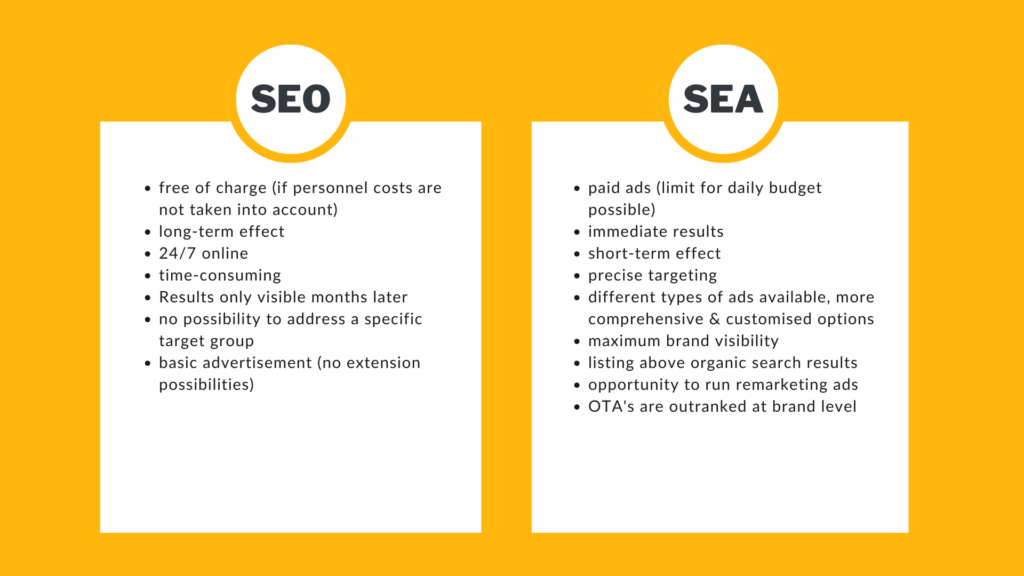
We give you an overview of the most important features and differences of SEO and SEA measures and reveal how you can use them to increase your direct sales.

Probably the best-known difference between the two strategies is the cost. While you have to pay for Search Engine Advertising (SEA), Search Engine Optimisation (SEO) measures do not involve advertising costs. SEO initially offers the advantage that the work you invest in search engine optimization pays off around the clock, unlike SEA campaigns, which go offline when the budget runs out.

However, SEO is generally a long-term measure that does not have an immediate effect. Nevertheless, structuring your website with subheadings or checking and optimising the loading time of your page can significantly improve your ranking in the search results. The disadvantage, in comparison, is the high amount of time and work involved as well as the lack of possibility to address a specific target group.

This brings us to SEA. Paid advertisements enable you to reach your target group as precisely as possible. In addition, unlike SEO, you do not have to wait months for results, but can perceive them directly. Furthermore, you have various options for your SEA campaigns. You can customise them or place ads specifically for special offers.

Through the many extension options, your campaigns also take up more space on the search results page and thus attract more attention to your hotel and your brand. Last but not least, SEA measures also offer you the possibility of placing “remarketing ads”. Here, travellers who have visited your website only once are subsequently shown ads that should lead them back to your hotel.

Both measures have their justification and should be applied depending on the objective. The following table provides an overview of the advantages and disadvantages:

We recommend that you consider both strategies, because SEO and SEA also benefit from each other. For example, the keywords chosen when setting up an SEA campaign can also be used in your meta descriptions as part of your search engine optimization and thus increase your ranking in the organic (unpaid) search results and increase the number of your website visitors.

Another important thing to know is that Google has introduced a “mobile-only” logic since 21 March. This means that all web content that is not optimised for mobile devices will disappear from Google’s organic results (SEO). However, to ensure that travellers can easily find you as long as you have not yet optimised your content for mobile, you should definitely be visible with your paid ads at this time.

To get the most out of paid search, we recommend hiring someone with experience and expertise in Pay Per Click campaigns. We not only have the necessary knowledge to run successful campaigns, but we are also Google Premium Partners.

So don’t hesitate to contact us for a free demo. Thus, we help you and your hotel to further expand your online success in the shortest possible time.

When trying to determine the success or effectiveness of a metasearch campaign, there are a number of KPIs or Key Performance Indicators that we need to take into consideration. These will tell us whether our campaign is successful or not and whether we might rethink our advertising strategy.

Those key performance indicators can be found on any metasearch, such as Google, Trivago, Tripadvisor & Co. They will help you to monitor your success. In this blog post, we will present you the most important KPIs and show what significance they have for your online campaigns.

#1: Traffic

In the context of digital advertising, traffic represents all visits that internet users make to a website. So in the context of metasearch, traffic is all visits that internet users make directly to a hotel’s website or booking engine via a metasearch link.

When we are talking about the hospitality industry, the most common way to drive traffic to a hotel website and it’s booking engine  is through ads placed on various metasearch platforms such as Google Hotel Ads, Trivago, Tripadvisor, Kayak etc., which help in directing internet users looking for accommodation options to the websites of hotels.

Regardless of whether we are talking about traffic to a hotel website or traffic to a website of any other company advertising their products and services online, traffic is important because the number of visitors coming to a certain page represents the equal number of opportunities a business has to potentially turn a visitor into a buying customer.

Quantity or quality?

When we talk about website traffic, traffic quantity is just as important as traffic quality. While high traffic might mean that we are getting many visitors to our website, it might not necessarily mean that these visitors are good quality leads that are actually ready to purchase what we are selling.

From the standpoint of a hotelier, this means that not all users coming to his hotel’s website will also complete a booking.

High quality traffic represents the volume of website visitors which fit the profile of your target audience that the content of your website resonates with and are thus more likely to convert on your website.

Note: Click here for our tips on how to boost visits to your website and convert it into actual reservations.

#2: Impressions

This KPI shows how often your metasearch link was shown to a user. In contrast to other metrics such as conversions, this is a non-action-based metric. It only gives an overview of how often users could potentially have seen the ad, but not whether and what actions the users took after seeing the ad.

Impression share plays a more central role in this context. It represents the percentage of impressions the ad received compared to the total number of impressions the ad could potentially receive (opportunities). The latter is based on the ad’s targeting settings, approval levels, bids, and quality scores.

Our goal is to achieve the right impression share to meet the expectations and revenue targets set for the campaign. A low impression share consequently means wasted potential and is an indication to improve the ad (if necessary with a higher click price).

#3: Clicks

Clicks are relatively easy to define as they are exactly that – clicks: The number of times users actually clicked on our ad. Clicks are an action-based metric, since the searcher has already interacted with our ad.

The number of clicks itself is rather irrelevant for success monitoring, much more decisive is the number of clicks in relation to the amount of impressions.

#4: Click-through Rate

This is a percentage of people who clicked on our ad after seeing it. From a marketer’s perspective this can be understood as a really important metric, because it impacts the quality score of metasearch ads and thus the ranking of the ad itself.

It also helps us understand user behaviour further down the customer journey and the sales funnel. A high number of impressions but a low amount of clicks results in a lower click-through rate and implies that there is something wrong with your ad. Something in the ad is not convincing enough for the user to click on it. A possible reason could be the fact that other advertisers are offering more attractive room rates (rate disparity) which demotivates the user to click on our ad.

#5: Cost-per-click (CPC)

The click price is the amount of money an advertiser pays for each click on their ad on platforms operating on a PPC (Pay Per Click) model. It determines the costs that an advertiser has when users are interacting with the ad.

The CPC is one of many factors that determine how your metasearch ad will rank, i.e. what position your ad will get in the price comparison. Metasearches are dynamic marketplaces, so it is essential to regularly check and adjust the click price in order to maintain or increase visibility.

The optimal CPC varies depending on the platform, the location, the number of competitors and the desired visibility level. A distinctive expertise and experience in bid management is crucial.

#6:  Conversions

Talking about turning visitors from mere window-shoppers to actual paying customers, we come to another important KPI: conversions.

In the world of digital marketing a conversion occurs every time a website visitor completes a certain action on that website, whether it is filling out a form, subscribing to a newsletter, buying a product or, in the world of hotels, booking a room.

Although more traffic to a website also means more opportunities to convert users into paying customers, that doesn’t necessarily mean a higher conversion rate. This is the percentage of people who visited a website and actually completed a conversion out of the total number of visitors.

e.g.: If you have 200 website views and 5 bookings in one day. This results in a conversion rate of 2,5%. ( 5 / 200 * 100 = 2,5%.)

But how to define a “good” conversion rate (CVR)?

The average conversion rate is not an absolute KPI and should therefore be viewed in relative terms, as it depends heavily on various factors, such as the metasearch channel. Furthermore also the traffic has a significant impact.  The higher the volume of visits on the link, the more likely it is that the conversion will be lower.

Nevertheless, a low conversion rate despite high traffic often indicates that there is a need for action on the website,  booking engine or price optimization. Reasons for this could be, for example, unattractive content or a booking process that is too complicated and time-consuming.

Note: Click here for our tips on how to make your website more bookable and perfect your online presence.

#7: Return on Ad Spend (ROAS)

Another important factor that should be considered is ROAS. This key figure is an indicator for the profitability of the advertising spend and shows the achieved return per marketing spend. Calculating the ROAS tells us whether our campaign budget generates sufficient revenue.

We calculate the ROAS by dividing the revenue generated by a campaign with the cost for that campaign: Revenue / Cost = ROAS. As a rule of thumb a good ROAS is the ratio of 4:1.

This KPI is especially relevant when it comes to evaluating the efficiency of a campaign, comparing different campaigns with each other, or making decisions about optimizing or shutting down ads.

#8: Cost-per-Revenue (CPR)

At the end, we would like to explain the CPR to you. This metric defines the ratio of cost to revenue.  It measures the cost you pay for the revenue generated when you run metasearch ads. This KPI is similar to ROAS, but is calculated in reverse.

It can be calculated like this: CPR = Costs / Revenue * 100

Basically, the lower the CPR, the more successful your campaign. Nevertheless, a very low cost ratio also shows that revenue may have been given away. After all, higher investment in an efficient metasearch campaign means higher profits, which flow directly into your company.

Conclusion:

There are a number of different metrics that can be used to measure the success of your metasearch campaigns. However, it is important not only to look at the numbers in an isolated way, but rather in correlation with one another and to interpret them correctly. This requires time, resources and know-how.

That’s why, as part of our campaign management and full management, a personal expert is available to take on this task for you and carry out regular checks and analyses, as well as implementing appropriate optimization measures: this is how your metasearch campaigns become a success.

Regularly maintained content not only improves your click rate, but also your ranking in search engines. The design is not the only decisive factor for long-term success, but above all: interesting and up-to-date content – your hotel website is only as useful as the information provided on it.

But what exactly does content marketing mean?

This can be understood as a marketing approach aimed at the regular distribution of high-quality content with significant added value for users. It describes how you distribute content, i.e. texts, images, videos, etc. All content should be customized to the needs and benefits of the guest segments. This not only makes your hotel better known by supporting your online reputation, it also differentiates you strongly from your competitors. This means more visitors to your hotel website and increasing room reservations.

Searching before booking

Before a potential guest books a hotel, one first searches online for information on how to get there, the surroundings and sights, or gets inspiration about the country and its people. This is where you should take the first step for informative, relevant and unique content. Because not only recommendations of other guests are decisive when booking a hotel, but also the hotel website with its content, such as the service, hotel rooms, breakfast or bicycle rental. The main goal is to satisfy the guests’ need for information and to use content formats that create a desire for more.

Offer interesting content for your target group

Contribute to the unique profile of your hotel by presenting the content that is interesting for your guests. Is it the idyllic location of your hotel, the varied breakfast, your own boat rental, a large wellness area or a children’s paradise that characterizes you? Help your guests discover why your hotel is special and stands out from the rest.

Before you choose the content, you should first ask yourself what message you want to convey and who exactly fits your target group. Who are typical regular – or even dream guests? What is important for these hotel guests during their stay? And why exactly should these travelers book your hotel?

While the preferences of a business traveler are more in a central environment, a large bed, a TV and a big window, leisure travelers tend to prefer pool pictures and the hotel’s surroundings when booking a hotel. Therefore, provide images on various platforms that reach each target group individually.

What needs to be considered?

The focus of content marketing is not the hotel’s offer, but the added value for the customer. With access to texts, images, videos, graphics and ratings, you entertain your guests, create your own image and build trust. After all, it’s all about the content, information and inspiration that binds your customers emotionally, increases your reach and clearly differentiates you from the competition.

1. Content idea and quality

Good content always starts with an idea, which should start from the USP, your unique selling point.  A common mistake in content marketing is that hotels produce content – but in most cases this content does not exactly represent its values. So before you create content, the first step is to think about what you want to tell and show your customers. Potential guests should be able to see through your content exactly what is your USP.

2. Content creation

There is a difference between dynamic and static content.

  • Dynamic content: availability, rates, cancellation conditions
  • Static content: pictures, information about facilities and amenities

But this blog post focuses exclusively on static content. A Tripadvisor study proved that travelers are 150% more engaged in ads with more than 20 photos. Therefore, the following requirements should be considered especially for pictures:

  • at least 20 photos per hotel
  • 4 or more photos per room including 1 photo of the bathroom
  • Pictures of important facilities (restaurant, bar, fitness, spa)
  • Labeling of all images
  • High quality and resolution

Especially static content should be compared across different channels to avoid discrepancies. In addition, make sure that the content is always up-to-date and that outdated content, such as renovation information, is removed in time.

Does the content have to be changed or edited regularly?

Yes, especially Google rewards up-to-date content with a better ranking, i.e. a better position in the search results. So find the mix of constantly optimized and new content.

3. Content translation

Especially with texts it is important to find the right words to convince potential guests of your offer and hotel. However, in order to address target groups from other countries, you should make sure that the translation is correct.

Don’t just look at the content for one country. Check the different country versions, especially those that generate unexpectedly few bookings, as the display often varies.

4. Content distribution

There are numerous channels to distribute your content. Whether on OTAs, such as booking, expedia and HRS, meta searches, like trivago and Google, your own website and IBE, social media or listing services, as mybusiness – you decide. A content database is an excellent tool to collect content such as text documents and images and distribute them later on the channels.

Price as a success factor for metasearch campaigns

Metasearch campaigns not only enhance your online visibility, but also increase your website visitors and consequently your direct sales. However, a successful campaign is definitely not a foregone conclusion, but depends on various aspects. One of the most important aspects is the price.

While online travel agencies profit from their high profile and thus encourage users to book, you can also gain a decisive advantage in the metasearch competition by directly linking your hotel website with the best price. For the majority of users, the price is still the decisive incentive to book a hotel.

But the best price offers you even more advantages:

  • lower commission costs
  • Data of your target group/ guests
  • proven fewer cancellations
  • better customer loyalty

Why are competitors sometimes offering lower rates?

In the price comparison on metasearches it is often the case that a large number of providers are offering rates on the same hotel. Since booking.com, zenhotels & co. also know that the price is the key argument for potential hotel guests, the providers also try to offer the lowest rate, for example by reducing their own margin.

Sometimes it is also due to the hotel itself as special conditions are switched on the OTAs, which are not offered on their own website. The reason behind these measures is highly questionable.

Besides that, there can also be completely different reasons for undercut rates. For example, technical problems with the transmission of rates.

As you can see, there are a whole range of factors that can hinder your pricing policy.

But how do you ensure the best price?

Permanent rate monitoring is the buzz word here. This can take a lot of time manually due
to the many different providers – time that most hoteliers do not have. Moreover, it only provides
a partial view of the situation. To get a complete overview is simply not possible manually.

The solution: A tool that automatically handles rate monitoring for you, such as the
myhotelshop Rate Inspector.

With the Rate Inspector you keep control over your rates and thus create the basis for a successful metasearch campaign:

  • Benefit from rate monitoring on the largest travel platforms such as Google, Trivago and TripAdvisor.
  • You can see at a glance how your website performs compared to other providers of your room rates.
  • 10 price checks per day per meta search: Trivago, TripAdvisor & Google Hotel Ads
  • Receive price-check data for the next six months in advance.
  • You can view all data in a bundled overview on the portal and easily analyze the results of the tool.

Discover the reason for undercutting rates

Next to the respective hotel you will find a list of the corresponding platform of the rate check as well as further travel information of the checked date. The Rate Inspector provides you not only with information about which competitor has offered a cheaper rate, but also the exact price and your offered rate. In addition, a corresponding screenshot and a link allows you to take a closer look at the facts and check them again. Thus you get all the information you need to take any necessary steps to stop these cheaper rates from the competition in the future.

You would like to see the Rate Inspector in action? In our online seminar we will give you even more insights into the tool. Otherwise, you are of course welcome to contact us at any time.

But not only that: even when looking for the best and cheapest hotel, the most used search engine in the world enjoys great popularity – one more reason to consider this marketing channel. In our latest blog post you can find out everything about the successful product Google Hotel Ads and the new offshoot Promotions Ads.

But what exactly is this marketing format about? 

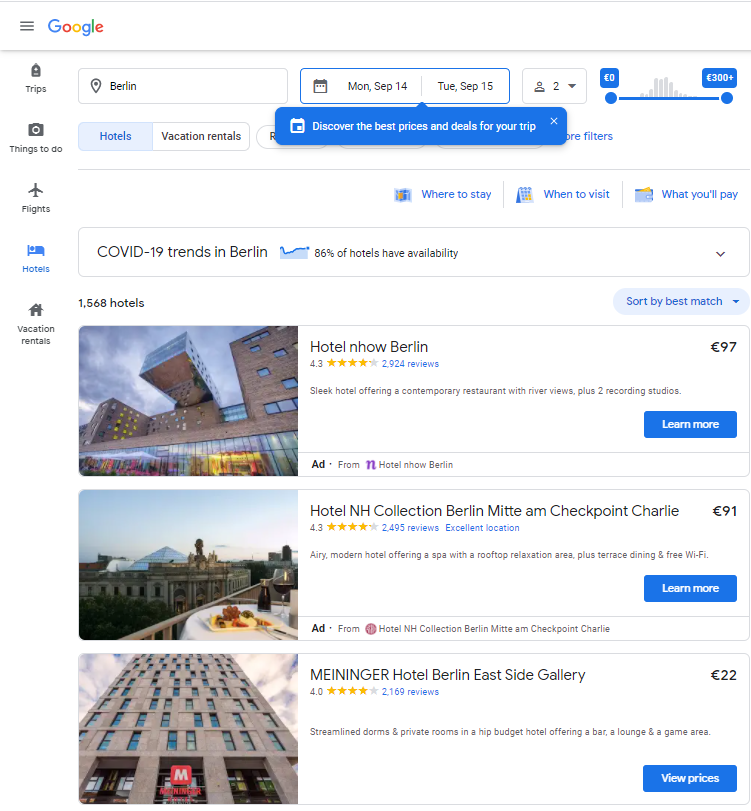
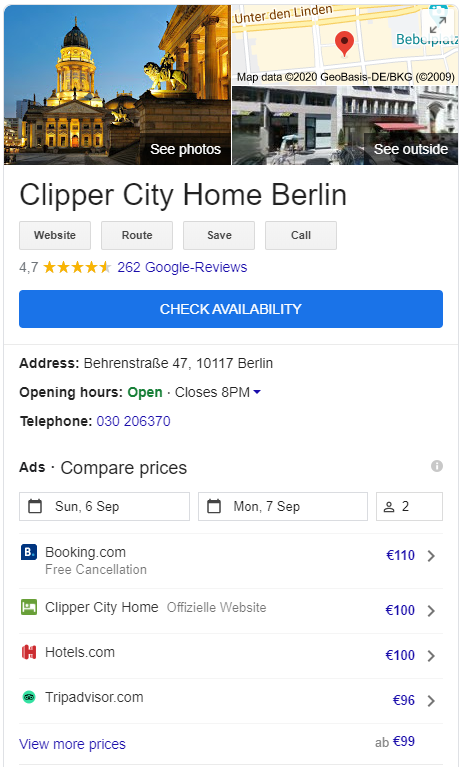
If a user searches specifically for your hotel, the business entry of your hotel is displayed, including photos, address data as well as availability and a price comparison for the specified travel dates with a direct link to the booking page. This is actually Google Hotel Ads.

In fact, you benefit not only in the case of a specific search for your brand, but also in the case of a generic search by users, for example with the term “Hotel Berlin”. In addition to the text ads, the hotel detail map immediately catches the eye and attracts a lot of attention due to its dominance in the upper field of the view.

Here, selected hotels are suggested for the appropriate travel period including the price and an rating. If you now click on one of the displayed hotels, you will get to a hotel-specific page with availabilities, price comparison, booking function, guest opinions and the accommodation features.

Since February, hoteliers have yet another possibility to pick up the users thanks to Promoted Ads. This newer product of google allows to be even more visible to these generic searches. The Promoted Ads are the top positions in the ranking which are marked with the term “ad”. If the user now clicks on the hotel, he or she is taken to a hotel-specific page on which further rates are shown with the appropriate website link.

Is it really worthwhile to place such ads?

Whether with the classical Google search or with maps – no one can get past the hotel ads. Thus you can attract the attention of a large number of users and lead them directly into your booking page via Google Hotel Ads or promoted links and turn them into your next hotel guests.

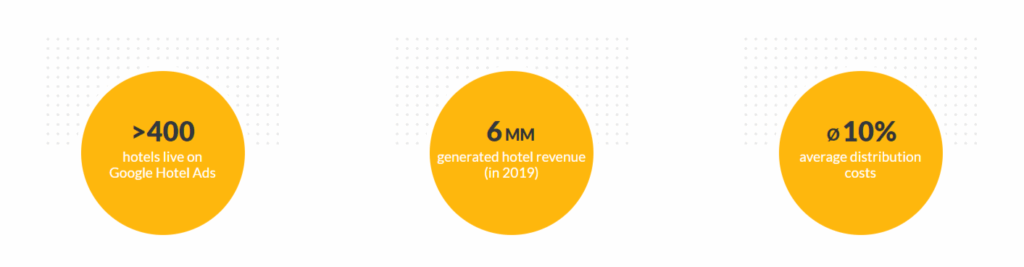
The numbers of our customers speak for themselves:

Three levers for successful direct sales: Google Hotel Ads, Google Ads and Promoted Ads

For a lasting increase of your direct sales, it is recommended to use all three marketing formats, since they influence each other significantly in the Google search results. Therefore the products should be coordinated and monitored. The adaptation and the support of the campaigns are therefore very extensive and require a certain know-how – resources that most hoteliers do not have. For this reason, it is recommended to have all three products managed by one provider in order to achieve the best results.

As a certified Google Premium Partner, we have the necessary knowledge when it comes to how the campaigns work. With regular training courses and exchanges with Google, we can optimally manage your ads and increase your visibility and thus direct bookings in the long run.

Keeping everything in view with an impressive reporting 

Of course, as with all other metasearch campaigns, you will have access to a complete reporting of your results from a clear overview in our myhotelshop portal. Thereby, we no longer provide you only with the classic KPI’s, but with a range of additional information, which is used for an in-depth analysis of the results and the control of your campaigns:

Tip#1: Design

A well-structured booking engine (IBE), which creates a harmonious overall picture, not only makes a good impression, but also encourages booking. 

Consistent design

First and foremost, the design of the IBE should match that of the hotel website. Therefore, use a consistent color scheme and the same fonts to convey a unified brand image.

Optimized Header

In addition, an optimized header should always be visible, which contains the hotel logo and the advantages of direct bookings. This way, guests know during the entire booking process in which hotel they are booking and can establish a relationship with the hotel, which is essential for brand awareness. An optimized header is also useful for guests who enter your booking engine directly via trivago or Google Hotel Ads. This way they know directly in which hotel they are located.

However, you can also offer your guests the option of returning to the hotel website at any time in the case they wish to find out more information about your hotel.

Pictures

Furthermore, hotel pictures build certain expectations and create the conditions for a positive guest experience. Therefore you should also work with pictures in your IBE. An appealing background image in the right size as well as photos of available rooms will arouse the desire of your guests to travel and make it easier for them to choose the preferred room.

Tip#2: Room and rate structure

The price is one of the most important factors in the booking process. Guests want to see your advantages at a glance and always want to book at the lowest price. 

A good room and rate structure is therefore essential to provide your guests with a clear offer of your services.

Quantity and quality 

First of all, you should make sure to offer a reasonable number of rooms and rates, which should also be clearly and attractively named. On the one hand, you should provide several rates to cover the different needs of your guests, but on the other hand, you should not provide too many rates to choose from, as this can be unstructured and overwhelming for visitors.

Ascending order

In addition, many guests choose the booking channel directly via the hotel website in order to take advantage of the guaranteed best price and book at the lowest rate. Therefore, you should always place the cheapest rate and room category at the top of the list and sort by price in ascending order to provide potential guests with an uncomplicated booking experience.

Rate monitoring 

An important key to success in convincing users is your price. With the right rate structure, you can provide the customer with an attractive offer on your website, giving them a good reason to book directly with you.

Our Rate Inspector gives you a clear overview of the rates of your website compared to your room rates of other competitors like booking.com, Expedia & Co. This allows you to monitor your prices on all meta platforms and react quickly to price differences in order to always offer the best price on the hotel website and increase your direct bookings.

Tip#3: Offers

In addition to the available rates, special offers should also be added, which provide additional services in the form of a complete package. 

Attention: Check if your offer really matches an arrangement! A breakfast for an overnight stay is not an arrangement, but rather a standard rate. In the form of an arrangement, for example, overnight stays, breakfast, a welcome or farewell gift, a 3-course menu and the free use of the sports facilities could be offered in a complete package. It is important that the arrangement always offers a meaningful added value for the guest and that this is also recognizable in the price.

The services and contents of the arrangements should be presented clearly and shortly in your booking engine, ideally in key points.

Diversity

There are no limits to the range of arrangements. In addition to wellness, holiday or gourmet arrangements, you can also add tickets for attractions to your offers in cooperation with leisure providers in your area.

Availability 

If you decide to offer arrangements, you should always make sure to include enough references and links to available and current offers both on your website and in your booking engine.

Actuality 

In addition, these should be kept up-to-date at all times so that you do not present outdated offers to your guests.

Thematic grouping

A theme based sorting of the arrangements into for example, seasonal offers (winter special or summer special) or top sellers attracts the eye, ensures a clearer presentation and helps with orientation in the booking process.

Attention: According to the Package Travel Directive of 2018, your offers cannot be called “arrangement” or “package” anymore. You have to call them “offer” on the website and booking engine. This is related to a changed liability on the part of the hoteliers. If you are not insured against this, the wording “Arrangement/Package” can cause problems!

Tip#4: Booking process

Ensure a fast and uncomplicated direct booking experience. 

To lead potential guests to a booking, you should first and foremost use a fast and intuitive booking engine. The guest should always know how many booking steps lie ahead. If the booking process takes too long, many potential customers will stop it and move on to your competitors.

Few mandatory fields 

Make sure that you only ask for meaningful mandatory fields in the data query, i.e: as much as necessary but as little as possible. In addition, you can make the single steps of the booking process visible in the form of a bar or numbering so that the user knows at any time at which step he is currently and how many steps still lie ahead.

Cancellation policy

In addition, the cancellation policy for each rate being offered should be clear and understandable, so that the traveler is aware of the conditions. This will save you calls to the reception desk, which in turn blocks your staff and employees.

Multiple payment options

With several payment alternatives, you can also enable your guests to choose any payment option they like – another advantage to get guests to book your hotel.

Mobile view

Last but not least, just as with your website, mobile optimization of your booking engine is very important. Many business and private travellers book a hotel room while on the way on mobile devices. Therefore you should also adapt your IBE for mobile use.

Important: Always be open for feedback from your guests! Whether on the phone or at your hotel – in the end, your guests are the test whether your booking engine is well set up or not. Some booking engines have an integrated feedback function (Hotelnetsolutions). Activate this function and check it regularly. 

With these 4 tips you will not only increase your brand awareness, but also increase the number of commission-free direct bookings. We would be happy to advise you on further optimization possibilities for your IBE within our service full management. Feel free to contact us at any time at business@myhotelshop.de.

Let’s first look at the search behaviour of the users. In Germany, 93% of Internet users research online for their holiday. Of these, 56% search via Google. These statistics illustrate the great potential of Google ads for the hotel industry. Compared to classic brand campaigns (placement of ads for your hotel name), generic campaigns, however, are mainly focused on the acquisition of new customers.

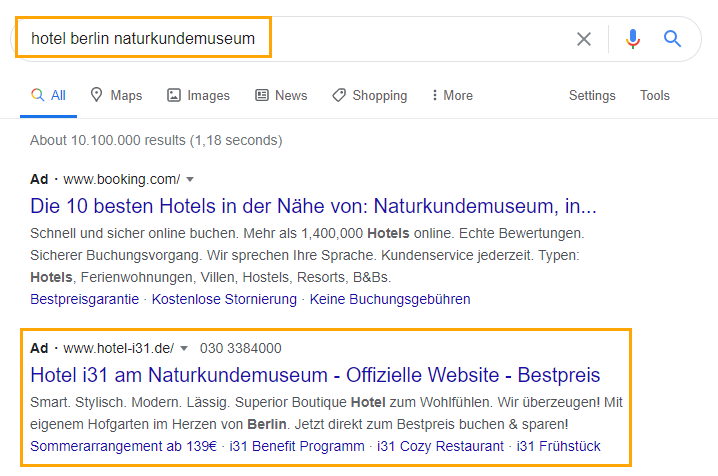
But first things first. What exactly is meant by a generic campaign?

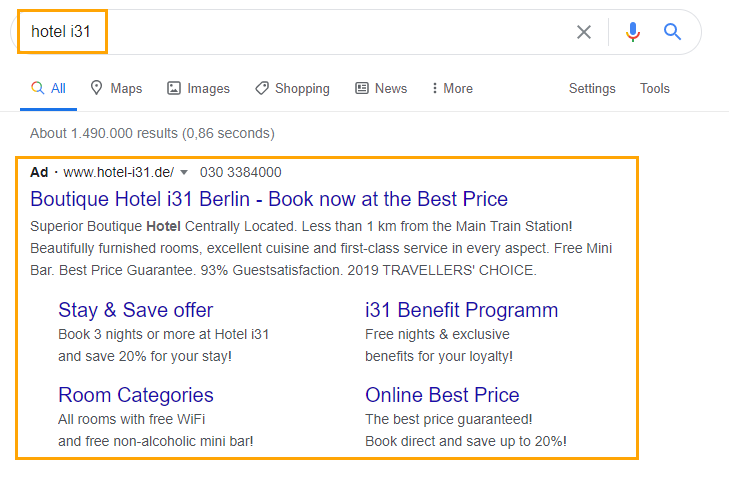
In contrary to this, with brand campaigns the hotel name is searched directly:

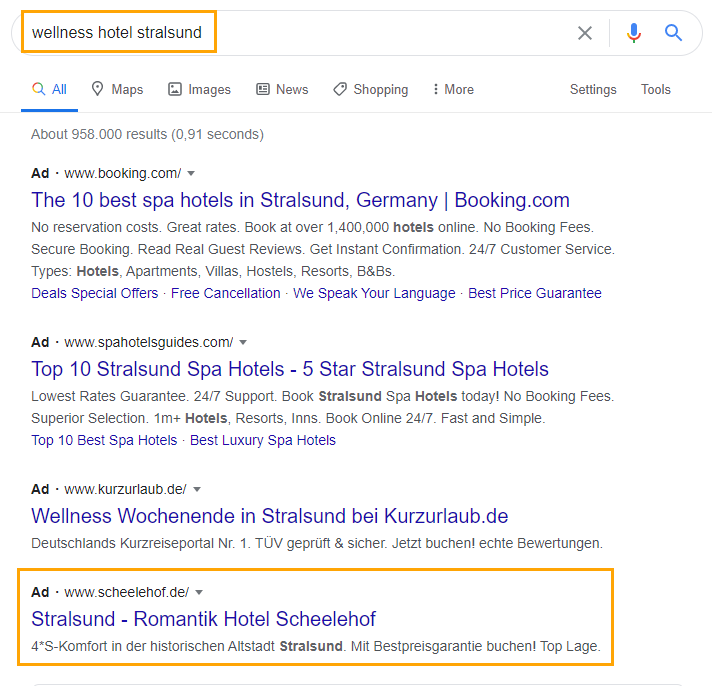
Potential guests are often not necessarily looking for a specific hotel, but rather have only a vague idea of their holiday or business trip at first. For example, they are initially interested in a wellness hotel on the Baltic Sea in a certain period of time or a hotel in Berlin that is located in the city centre. This is exactly where the generic terms come into play, such as “Wellness hotel Baltic Sea” or “Hotel Berlin city centre”. These are so-called keywords. In most cases they are structured according to the scheme “hotel type + location” or “hotel type + location + period of time”. If you run campaigns for these keywords, users will become aware of your hotel.

With different keywords or keyword combinations you can cover a wide range of topics related to your hotel and generate a high reach. This is because generic terms are in high demand and with a click on your ad, users are taken directly to your hotel website, where they can find out further information or, in the best case, book directly.

What are the concrete advantages of generic campaigns on Google?

1. High range

Generic campaigns are mainly characterized by a high reach. While brand campaigns are usually used to search for a specific hotel with a strong booking intention, visitors click through various ads in the generic search to find inspiration. As a result, the traffic of generic campaigns is much higher and offers the opportunity to win new customers. Whether with low generic campaigns such as “Hotel near Berlin train station” or high generic campaigns such as “Hotel Berlin” – you have the opportunity to grab your customers right at the beginning of the Customer Journey, to draw attention to yourself and finally to inspire them.

2. Potential to increase Occupancy rate

Generic campaigns are an excellent tool to increase your occupancy rate in the short term if required. New users are attracted to your website, as your hotel is advertised to people who are generally interested in an overnight stay or an arrangement, but are not yet familiar with your hotel brand.

3. Control of the traffic

Another advantage of generic campaigns is that you can control the traffic in terms of your target group. For example, if potential guests are looking for a luxury apartment or a wellness hotel in a certain region, their needs will quickly become clear. However, you may not yet have been able to attract the attention of this specific target group. Now you can run generic campaigns with the keywords “wellness hotel Baltic Sea” or “luxury apartments in Berlin”. This way you will reach your target group where potential guests are already looking for you.

4. Push vs. pull marketing

Even if the reach of generic campaigns is significantly increased compared to brand campaigns, we can still speak of pull marketing. With push marketing, you try to show your advertising to potentially interested parties, e.g. in the form of banners on the Google display network or on Facebook. With generic Google Ads campaigns, on the other hand, you address users who are already looking for a solution to their needs. In your case, generic search network campaigns are where travelers first want to get more information. Now you “only” have to “pull” them to you. High-quality advertisements appeal to potential guests, create interest and ideally a bond. If the user does not book directly, there is still the ideal starting position to motivate the customer to book with a push (e.g. remarketing) or brand campaign.

Conclusion: With generic campaigns you reach users who are already looking for your offer – the need to search for a hotel does not have to be created.

However, many hoteliers have a wrong understanding of the costs of generic Google Ads campaigns. While brand campaigns can achieve a high conversion rate with just a few clicks, generic campaigns with more clicks generate relatively few bookings. This results in a rather high cost ratio.

Does this mean that generic campaigns are not worthwhile?

Far from it. With generic campaigns, visitors are still in the research stage, trying out several ads and clicking through different offers. This causes higher costs than brand campaigns, but also appeals to a whole new group of customers who would otherwise not have noticed your hotel at all. It therefore has a strong advertising effect.

In addition, not using generic campaigns also has an effect on the revenue of existing brand campaigns. We have already seen that traffic on brand campaigns without the use of generic campaigns has fallen by up to 50%. The reason for this: without generic campaigns, guests do not even look for your hotel in the first place. The connection between brand and generic campaigns is obvious. Many customers search for a hotel via generic keywords, click on several ads and finally decide on a hotel (brand campaign) where they book. This means: Without generic campaigns – no new customers. One more reason to rely on advertising with generic campaigns.

5. Long-term branding effect

Last but not least, more conversions (bookings) can be controlled with search engine marketing – especially with generic campaigns. If guests become aware of your hotel through a generic ad today, they will book again later – whether through a brand campaign or directly on your website.

6. Strong search volume

The search volume is decisive for the reach of search engine marketing. This indicates how often a keyword is used in a web search. Keywords with a low search volume therefore achieve a lower range than keywords with a high search volume. With the help of the Google Keyword Planner you can not only determine the monthly search volume of keywords, the tool also shows the development of keywords over time and suggests new keyword ideas based on your domain. It is therefore important to generate not only as many visitors as possible, but also the right visitors to your site through optimally targeted ads on relevant keywords.

That means: Draw attention to your hotel today and turn visitors into guests!

In short, generic Google Ads campaigns are the key attracting guests to you. We kindly recommend our online seminar by our CEO, Ulli Kastner, where you can find further information.

Do not hesitate to contact us if you have any further questions, we will be happy to advise you regarding Google ads at business@myhotelshop. de or +49 (0) 341 / 392 816 751.

But why does the rate structure play a crucial role especially on Trivago, Google & Co.  

…Traditional sales are decreasing, online bookings are increasing!

Electronic bookings via online booking platforms (OTAs), e-mails, booking systems or contact forms on hotel websites are becoming more and more popular every year, as the following figure shows. Distribution is shifting from offline to online sales.

OTAs in particular are on the upturn: within ten years their market share has risen to 20.9% in 2012. The direct business is suffering noticeably from the growing dominance of online booking portals.

Why are online booking portals so popular?

The main reason is that hotels have not managed to get online in time and that business and contract models have changed. As a result, prices have been transferred from traditional sales channels to the online world, where they provide more transparency. If prices are lower on such channels, travellers naturally choose these channels to book at reduced prices.

How are prices displayed in different channels?

Traditionally, hotels give their prices to tour operators, wholesalers, OTAs & Co. where these prices are then sold within those channels. However, this creates the following problem: the price is often not sold exclusively through this one channel, but is distributed online to other channels. This has a direct impact on the profitability of a hotel. Here is a practical example:

A hotel gives an OTA a room valued at 100,- EUR and 15% commission. She thus receives 15,- EUR when she sells for 100,- EUR. However, if the OTA receives availability for the same hotel and room from the tour operator or wholesaler, e.g. at a net price of €70, the OTA for example adds €25 and sells the room for €95. This makes it €5 cheaper than the hotel itself. This results in a margin of €25 on top of the €15 on the hotel. In total, this makes 10,- EUR more profit for the online travel agency. In the end, the hotel earns only 60,- EUR instead of 85,- EUR, because the tour operator or wholesaler also wants to get his share of the business.

Such serious price differences occur both with classic wholesalers and with OTAs, when a hotel issues special prices for certain markets. As a hotelier, you cannot rely on technical control in the background. Rather, it is important that you understand the interrelationships and partnerships of major providers and know which channels they serve. Therefore always read your contracts with them carefully to avoid risks!

What are the problems with the best price policy?

  • Lower net rates: Wholesalers, OTAs & Co. sell their rooms at lower rates via online channels.
  • Tour operators often sell your rooms, even if your hotel is already fully booked on other channels.
  • OTAs are sometimes cheaper than your own hotel website, because they do not charge their own margin or commission and thus undercut you as a hotel.
  • OTAs offer their customers a cashback system (discounts, vouchers) for room rates if they pay for their stay at the hotel (e.g. “11th night free”).
  • Price differences on several channels, e.g. because the rate exchange via the Channel Manager does not work properly or because of tax differences in foreign hotels.

Which impact does this have on your hotel and what measures should you take?

#1: Your reliability suffers

Pay attention to a clear pricing policy and make sure that, for example, a room on one day is not offered on four different channels at four different prices.

#2: Less control over your own visibility on Google & Co.

Manage your visibility by yourself, for example by offering a lower price on your own website than on other channels. If you give the lower price to other providers, these platforms control your visibility. So take action and control your visibility on the metasearches by yourself.

#3: More click costs for your metasearch campaigns

Offer the cheapest price on your own and pay a significantly lower Cost per Click (CPC), which means for example, for a room rate that is 5% cheaper than OTAs on average a 20-25% lower click price.

#4: Massively less profit

Increase your profit by selling rooms through your own website, because here you save the commission costs that you would otherwise pay to an OTA. The following example shows you how much more you can earn by increasing your own sales:

Booking.com sells your room for 62 EUR per day. You pay a commission of 18 %. A net price of 50 EUR remains. But your actual room price would be 67 EUR, which you offer on your own website, without commission, but with an average of 13% cost in the search engines. The net price would then be €58. This is a difference of €8 and a significant loss for you, because you not only offer your room on Booking.com for €5 less, but also pay 5% more commission (18%). This means that if you have 5 rooms, for example, your loss adds up to 40 EUR per day (5 x 8 EUR) or 14,600 EUR per year.

How important is having the best price on your website?

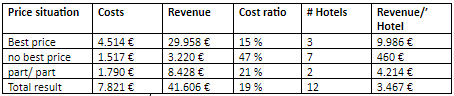
Now you are surely asking yourself, is it really worth offering the best price on your hotel website? Yes! The following example of a German hotel chain, for which we conducted an evaluation, makes it clear:

3 of the 12 hotels had the lowest price on their websites. This ensured a significantly higher visibility in the search engines, so that from the invested 4.500€ a turnover of about 30.000€ could be generated at a low cost ratio of 10-12%. In contrast, 7 hotels never offered the best price on their websites. The result: a cost ratio of 47%, because travellers who saw these hotels in the search engines booked the hotel room at a cheaper price at other providers. With a best price these hotels could have achieved a much higher turnover, similar to their competitors.

The analysis shows clearly that with the best price you can gain much more: less marketing expenditure, better performance and more profitability of the website.

Breaking your own dependence on the OTAs

With the lowest price on your website on the various metasearch platforms, you can increase direct sales and thus step by step free yourself from the reliance on Booking.com & Co.

Conclusion: What should you keep in mind with the best price policy?

Our recommendations are:

  • Do not work with net rates or contingents and make sure that you have strong control over prepaid rates.
  • Ideally, only work via two-way interfaces with OTAs on a commission basis.
  • Offer the best price in any case! Don’t leave the virtually secure bookings to tour operators or online booking portals
  • In general: Strengthen your own visibility, the number of website visitors and thus your direct bookings and establish your hotel website as a successful distribution channel in the long term.

Ullrich Kastner gives more information on the topic of best price in our online seminar. However, we would also be happy to look at your individual situation and support you in generating more bookings on your own website and strengthening your independence. Get in touch with us, we are at your side with our experience and know-how!

A major change is about to happen: from July, Google will no longer offer commission-based metasearch campaigns. The end of the CPA model (Cost Per Acquisition) means a significant change in advertising strategy for many hotels. But don’t worry – commission-based metasearch campaigns are still available with myhotelshop.

What options do you have now?

If you stop your meta campaigns, your hotel will increasingly lose visibility on the Google Hotel Ads platform and guests will be more likely to book via OTAs or not book at all in future. In this case, the worst possible outcome would occur.

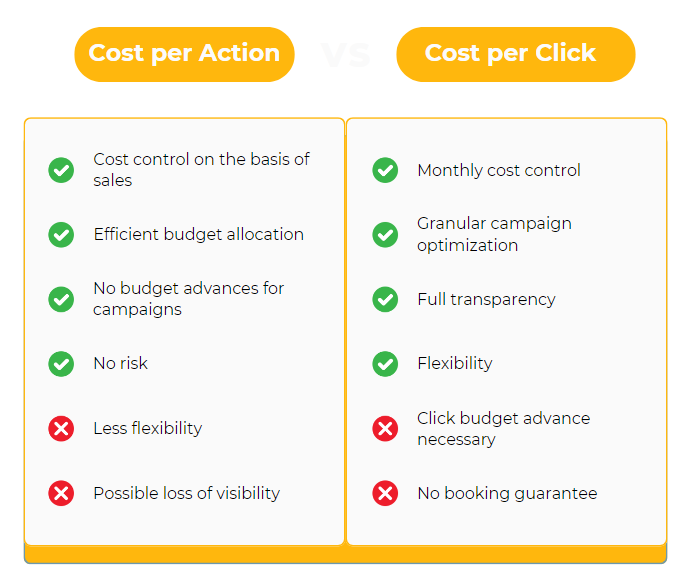
Instead, you should switch to alternative advertising models and adapt your marketing strategies accordingly. This could mean switching to the cost-per-click (CPC) model, where hoteliers pay for clicks regardless of whether a booking is made or not. This model is riskier, but with optimised campaigns and professional monitoring, it can also prove to be more cost-effective.

However, the CPA model is still popular with many hotels as a lower-risk option. For this reason, we continue to offer you the CPA model for your meta search campaigns in addition to the CPC. The CPA model has proven to be an extremely successful way of utilising marketing budgets efficiently. By paying per booking, you always retain control over your marketing expenditure and minimise the financial risk. With myhotelshop, you have the option of adjusting the CPA value on a monthly basis. This means that you can react flexibly to market and demand variations.

A comparison of the two models:

Why you should rely on myhotelshop

  • Experience and expertise: myhotelshop has extensive experience and the necessary know-how in dealing with both the CPA and the CPC model. We have run numerous successful campaigns for hotels and know how to achieve the best results.
  • Personalised service: We offer customised solutions that are tailored to your hotel’s specific needs and objectives. Our experts work closely with you to develop and continuously optimise the best possible strategy.
  • Transparency and reporting: We provide you with detailed reports on the performance of your campaigns. You know at all times how your investments are being utilised and what results are being achieved. This transparency helps you to make informed decisions.
  • Ongoing optimisation: We continuously monitor and adjust your campaigns to ensure that you always achieve the best possible results. Our aim is to keep your marketing strategy dynamic and successful.

The discontinuation of the CPA model at Google does not mean the end of this efficient marketing strategy. With myhotelshop, you can still benefit from the advantages of the CPA model and optimise your marketing budget. However, the CPC model may also be a better fit for your hotel. Rely on our experience to successfully organise your hotel marketing strategy with CPC or CPA. Contact us today to optimise your hotel.

A major change is about to happen: from July, Google will no longer offer commission-based metasearch campaigns. The end of the CPA model (Cost Per Acquisition) means a significant change in advertising strategy for many hotels. But don’t worry – commission-based metasearch campaigns are still available with myhotelshop.

What options do you have now?

If you stop your meta campaigns, your hotel will increasingly lose visibility on the Google Hotel Ads platform and guests will be more likely to book via OTAs or not book at all in future. In this case, the worst possible outcome would occur.

Instead, you should switch to alternative advertising models and adapt your marketing strategies accordingly. This could mean switching to the cost-per-click (CPC) model, where hoteliers pay for clicks regardless of whether a booking is made or not. This model is riskier, but with optimised campaigns and professional monitoring, it can also prove to be more cost-effective.

However, the CPA model is still popular with many hotels as a lower-risk option. For this reason, we continue to offer you the CPA model for your meta search campaigns in addition to the CPC. The CPA model has proven to be an extremely successful way of utilising marketing budgets efficiently. By paying per booking, you always retain control over your marketing expenditure and minimise the financial risk. With myhotelshop, you have the option of adjusting the CPA value on a monthly basis. This means that you can react flexibly to market and demand variations.

A comparison of the two models:

Why you should rely on myhotelshop

The discontinuation of the CPA model at Google does not mean the end of this efficient marketing strategy. With myhotelshop, you can still benefit from the advantages of the CPA model and optimise your marketing budget. However, the CPC model may also be a better fit for your hotel. Rely on our experience to successfully organise your hotel marketing strategy with CPC or CPA. Contact us today to optimise your hotel.