Generate even more direct bookings with best price: Why you should offer the lowest rate
Learn how to set the right hotel price to stay competitive, attract bookings, and avoid losing profits in the battle for the best deal.
Learn how to set the right hotel price to stay competitive, attract bookings, and avoid losing profits in the battle for the best deal.
Electronic bookings via online booking platforms (OTAs), e-mails, booking systems or contact forms on hotel websites are becoming more and more popular every year, as the following figure shows. Distribution is shifting from offline to online sales.
OTAs in particular are on the upturn: within ten years their market share has risen to 20.9% in 2012. The direct business is suffering noticeably from the growing dominance of online booking portals.
The main reason is that hotels have not managed to get online in time and that business and contract models have changed. As a result, prices have been transferred from traditional sales channels to the online world, where they provide more transparency. If prices are lower on such channels, travellers naturally choose these channels to book at reduced prices.
Traditionally, hotels give their prices to tour operators, wholesalers, OTAs & Co. where these prices are then sold within those channels. However, this creates the following problem: the price is often not sold exclusively through this one channel, but is distributed online to other channels. This has a direct impact on the profitability of a hotel. Here is a practical example:
A hotel gives an OTA a room valued at 100,- EUR and 15% commission. She thus receives 15,- EUR when she sells for 100,- EUR. However, if the OTA receives availability for the same hotel and room from the tour operator or wholesaler, e.g. at a net price of €70, the OTA for example adds €25 and sells the room for €95. This makes it €5 cheaper than the hotel itself. This results in a margin of €25 on top of the €15 on the hotel. In total, this makes 10,- EUR more profit for the online travel agency. In the end, the hotel earns only 60,- EUR instead of 85,- EUR, because the tour operator or wholesaler also wants to get his share of the business.
Such serious price differences occur both with classic wholesalers and with OTAs, when a hotel issues special prices for certain markets. As a hotelier, you cannot rely on technical control in the background. Rather, it is important that you understand the interrelationships and partnerships of major providers and know which channels they serve. Therefore always read your contracts with them carefully to avoid risks!
Pay attention to a clear pricing policy and make sure that, for example, a room on one day is not offered on four different channels at four different prices.
Manage your visibility by yourself, for example by offering a lower price on your own website than on other channels. If you give the lower price to other providers, these platforms control your visibility. So take action and control your visibility on the metasearches by yourself.
Offer the cheapest price on your own and pay a significantly lower Cost per Click (CPC), which means for example, for a room rate that is 5% cheaper than OTAs on average a 20-25% lower click price.
Increase your profit by selling rooms through your own website, because here you save the commission costs that you would otherwise pay to an OTA. The following example shows you how much more you can earn by increasing your own sales:
Booking.com sells your room for 62 EUR per day. You pay a commission of 18 %. A net price of 50 EUR remains. But your actual room price would be 67 EUR, which you offer on your own website, without commission, but with an average of 13% cost in the search engines. The net price would then be €58. This is a difference of €8 and a significant loss for you, because you not only offer your room on Booking.com for €5 less, but also pay 5% more commission (18%). This means that if you have 5 rooms, for example, your loss adds up to 40 EUR per day (5 x 8 EUR) or 14,600 EUR per year.
Now you are surely asking yourself, is it really worth offering the best price on your hotel website? Yes! The following example of a German hotel chain, for which we conducted an evaluation, makes it clear:
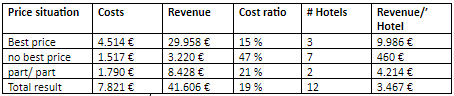
3 of the 12 hotels had the lowest price on their websites. This ensured a significantly higher visibility in the search engines, so that from the invested 4.500€ a turnover of about 30.000€ could be generated at a low cost ratio of 10-12%. In contrast, 7 hotels never offered the best price on their websites. The result: a cost ratio of 47%, because travellers who saw these hotels in the search engines booked the hotel room at a cheaper price at other providers. With a best price these hotels could have achieved a much higher turnover, similar to their competitors.
The analysis shows clearly that with the best price you can gain much more: less marketing expenditure, better performance and more profitability of the website.
With the lowest price on your website on the various metasearch platforms, you can increase direct sales and thus step by step free yourself from the reliance on Booking.com & Co.
Our recommendations are:
Ullrich Kastner gives more information on the topic of best price in our online seminar. However, we would also be happy to look at your individual situation and support you in generating more bookings on your own website and strengthening your independence. Get in touch with us, we are at your side with our experience and know-how!