Voice AI Agents for Hotels
How AI Voice Technology Is Transforming Hotel Bookings and Guest Conversations
Voice AI agents are reshaping how hotels handle reservations, guest inquiries, and service requests. From answering high-intent booking calls to supporting multilingual guests 24/7, modern voice AI has become a foundational layer in hotel operations—combining humanlike conversations with real-time automation.
- Aarushi Bansal
- Last Updated: January 12, 2026
- 15+ Min Read





The Definitive Guide to the Future of Guest Conversations
The way guests interact with hotels is changing rapidly. Phone calls, once the primary channel for reservations and service requests, are now competing with digital-first expectations for speed, accuracy, and availability. Yet voice remains the most high-intent and revenue-critical channel in hospitality, especially bookings, upgrades, and complex guest queries.
This is where Voice AI agent are redefining hotel operations.
Powered by advances in AI voice recognition software, natural language processing, and conversational AI, today’s AI powered voice assistants can understand guest intent, respond in real time, and complete actions such as checking availability, quoting rates, or logging service requests. Unlike traditional IVRs or basic chatbots, modern voice AI assistants are designed to hold natural, human-like conversations while operating 24/7 without staff fatigue.
Hotels across segments—from boutique properties to global chains—are now adopting Voice AI agent to reduce missed calls, automate reservations, support multilingual guests, and improve operational efficiency. As a result, voice technology is no longer seen as a “nice-to-have” feature, but as a core part of the automated hotel reservation system and broader guest engagement stack.

What Exactly Is an Voice AI Agent for Hotels?
An Voice AI agent (also called a voice AI assistant, AI-based voice assistant, or intelligent digital concierge) is an artificial-intelligence-powered system that speaks with guests over the phone or chat. It uses automatic speech recognition (ASR) and natural language processing (NLP) to understand spoken requests, then executes tasks or provides answers. In hospitality, an Voice AI agent acts like a 24/7 virtual concierge – booking rooms, answering questions, and resolving issues without human intervention.
For example, a guest might call and say “Book a deluxe room for tomorrow,” and the voice agent will parse that request, check availability in the hotel’s system, and confirm the reservation. In effect, it becomes an automated hotel reservation system or automated room booking system that handles guest interactions by voice, often across multiple channels (phone, in-app voice, messaging apps).
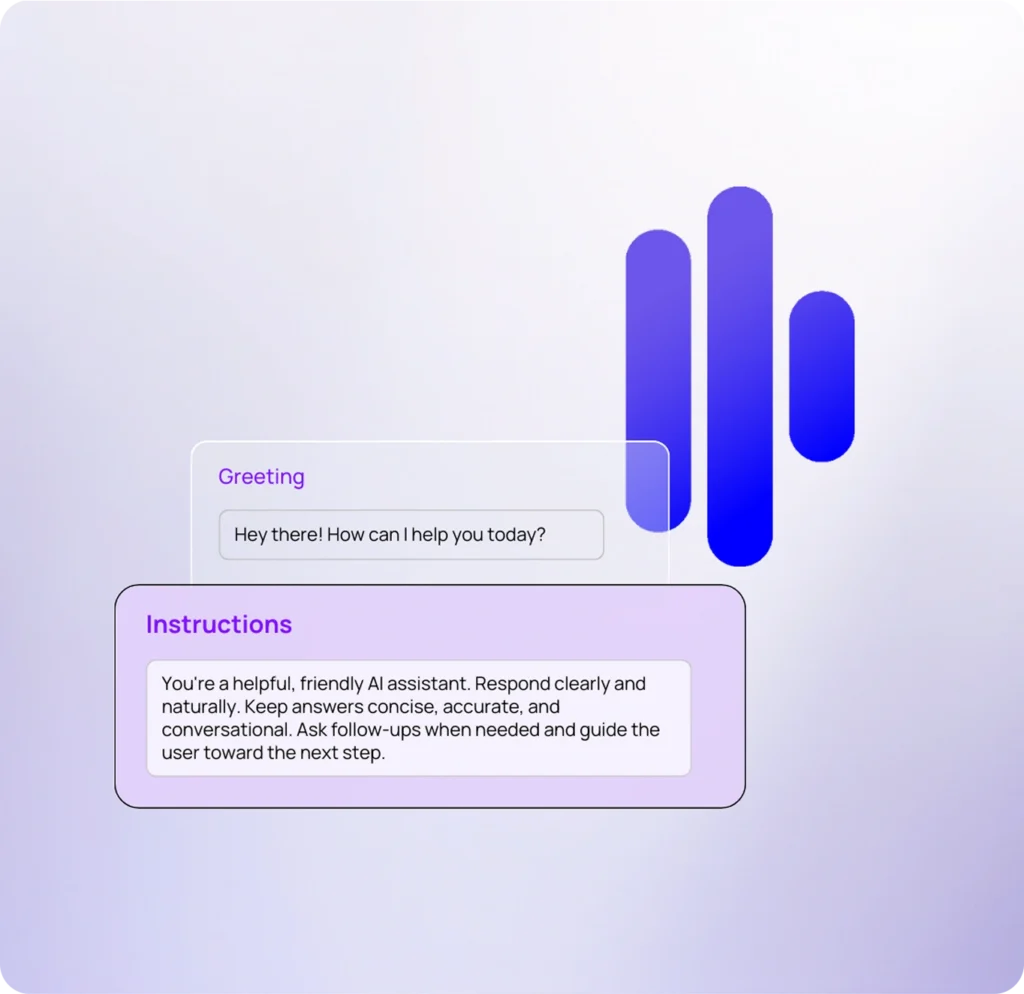
- Uses natural conversation: Guests talk normally (e.g. “Can I check in early?”) instead of navigating the menus. The AI remembers context and personal preferences, unlike rigid IVRs.
- Acts across channels: It may answer calls, texts, or voice messages (e.g. WhatsApp voice notes), providing a consistent “voice assistant AI” experience whether guests call in or message via the hotel app
- Integrates with hotel systems: It connects to the Property Management System (PMS), Central Reservation System (CRS), and other platforms so it can confirm bookings, modify reservations, and update guest profiles automatically
Why Voice AI Is Reshaping Hotel Guest Communication
Hotel guests have long relied on phone calls to ask critical questions – “Is breakfast included?”, “Can I upgrade?”, or “Can I modify my booking?”. These conversations, occurring across time zones and languages, profoundly influence bookings and guest satisfaction. Yet today’s front desks and call centers often can’t keep up: industry surveys indicate that up to 30% of guest calls go unanswered. Every missed call is a “silent revenue leak”: lost direct bookings, potential upsells and even repeat business In this high-pressure environment, AI-powered voice agents (also called Voice AI agent or AI phone agents) are emerging as a new “automation layer” in hotels, handling reservations and inquiries 24/7 with human-like speech and deep system integration. This report delves into why voice AI matters now, how it works, where it applies, and the tangible benefits (revenue, experience, and efficiency) it delivers in modern hotels.
The Case for Voice AI: Why Now?
Evolving guest expectations
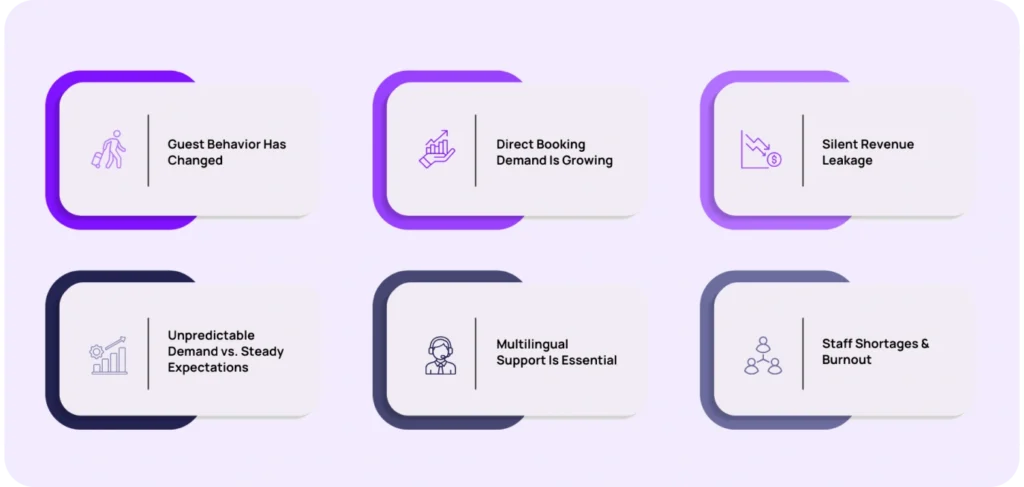
Today’s travelers are digitally savvy and impatient. They call hotels expecting instant, accurate answers. If a front-desk agent is busy or on vacation, the caller may hang up and book elsewhere. In fact, a recent hospitality industry analysis found 23–60% of guest calls simply are never answered. This isn’t due to staff incompetence, but capacity: a single agent juggling check-ins, walk-ins, and phone calls. Voice AI addresses this by providing an “always-on” receptionist that answers every call instantly.
Direct bookings on the rise
Global trends show travelers increasingly prefer booking direct with hotels (rather than via third-party sites), seeking better rates, personalization, or loyalty perks. However, hotels often lack the staff bandwidth to capitalize on this opportunity around the clock. An Voice AI agent captures high-intent callers 24×7, boosting direct booking conversions. For example, when every call is answered instantly, hotels typically see 7–15% increases in direct bookings within months.
Silent revenue leakage
Industry benchmarks estimate that during peak periods 30–40% of inbound calls go unanswered. Of those missed calls, 35–45% have real booking intent, with an average stay value of $150–$350. In practical terms, a 2,000-callper-month hotel with 30% missed calls could be losing $54,000 in potential booking revenue per month. Even recovering a fraction of those calls (e.g. 20%) yields $10–$11K extra per month ($130K/year). Voice AI effectively plugs this leak by answering every call and converting missed opportunities into confirmed bookings.
Unpredictable demand vs. steady expectations
Hotels cannot always predict intra-day surges – a group arrival late at night, a canceled flight, or an event weekend can flood phones. Meanwhile, guests always expect fast service. Traditional staffing is inflexible, whereas AI scales instantly with call volume. Seasoned travelers now compare hotels to Google or Amazon: they expect “Alexa-like” responsiveness from any service, including phone calls. Industry thought leaders note that hospitality is entering a “voice-first” era, where voice is the most human and urgent communication channel
Multilingual necessity
Global travel means diverse languages. Delivering consistent service across English, Mandarin, Spanish, and many more is costly with human staff. Modern voice AI agents support 20–30+ languages and accents. They automatically detect and switch languages, ensuring all guests – whether calling from Europe, Asia, or elsewhere – get clear answers. This multilingual support is no longer a luxury but a competitive must-have in world-class hospitality.
Staff shortages and burnout
The entire hospitality sector is facing labor constraints. A PwC survey finds >70% of hotel executives are pushing to automate operations to relieve staffing pressure. Voice AI directly reduces repetitive call volume, freeing staff for higher-value tasks. This lowers turnover and stress: hotels implementing AI report a drop in phone-related fatigue and complaints, and an increase in employee satisfaction.
How a Voice AI agent differs from IVRs and Chatbots
Hotels have used IVRs, basic chatbots, outsourced call centers, and automated switchboards for years. But none of these were designed to handle the messy, nuanced, real-world nature of hospitality calls.
Interaction & Conversation Model Comparison
| Dimension | Traditional IVR | Basic Chatbots | Voice AI agents |
|---|---|---|---|
| Interaction Style | Menu-driven | Keyword-based | Conversational |
| User Input | Button presses | Typed text | Natural spoken language |
| Conversation Flow | Linear | Semi-linear | Multi-turn, dynamic |
| Handles Unexpected Inputs | No | Limited | Yes |
| Natural Speech Understanding | No | Limited | Yes |
Language, Speech & Recognition Capabilities
| Dimension | Traditional IVR | Basic Chatbots | Voice AI agents |
|---|---|---|---|
| Spoken Language Support | Basic | None | Advanced |
| Accent Recognition | No | No | Yes |
| Tone Interpretation | No | No | Yes |
| AI Voice Recognition Software | No | No | Yes |
| Multilingual Support | Very limited | Limited | Extensive |
Context, Memory & Intelligence
| Dimension | Traditional IVR | Basic Chatbots | Voice AI agents |
|---|---|---|---|
| Conversation Context Retention | None | Minimal | Full |
| Multi-Turn Conversations | No | Limited | Yes |
| Memory of Previous Inputs | No | Session-based | Continuous |
| Intent Detection | Rule-based | Keyword-based | AI-driven |
| Learning Over Time | No | Minimal | Yes (machine learning) |
Personalization & Guest Awareness
| Dimension | Traditional IVR | Basic Chatbots | Voice AI agents |
|---|---|---|---|
| Guest Profile Awareness | No | Limited | Yes |
| Loyalty Data Access | No | Rare | Yes |
| Personalized Responses | No | Basic | Advanced |
| Contextual Recommendations | No | No | Yes |
| Awareness of Past Interactions | No | Limited | Yes |
Omnichannel & Multimodal Capabilities
| Dimension | Traditional IVR | Basic Chatbots | Voice AI agents |
|---|---|---|---|
| Voice Support | Yes | No | Yes |
| Text Support | No | Yes | Yes |
| Multimodal Experience | No | No | Yes |
| Context Shared Across Channels | No | No | Yes |
| Seamless Channel Switching | No | Limited | Yes |
Escalation & Human Handoff
| Dimension | Traditional IVR | Basic Chatbots | Voice AI agents |
|---|---|---|---|
| Recognizes Need for Human | No | Limited | Yes |
| Automatic Escalation | No | Rare | Yes |
| Context Passed to Human | No | No | Yes |
| Guest Repetition Required | Yes | Often | No |
| Complaint Handling | Poor | Limited | Intelligent |
Challenges with Current Hotel Call Systems with Voice AI agent Solutions OR Why Legacy Hotel Call Handling Fails Today’s AlwaysOn Guests
Missed Calls & Revenue Loss
Traditional hotel call systems leave a significant portion of inbound calls unanswered, with hotels missing up to 40% of booking-related calls during peak periods. Each unanswered call represents a lost revenue opportunity, as guests rarely wait or call back and instead book with a competitor. Most hotels lack visibility into how many bookings are lost due to missed calls, creating invisible revenue leakage that goes unmeasured and unaddressed. Staffing limitations further restrict the ability to scale call handling during high-demand periods , resulting in lost bookings, missed upsell opportunities, and a growing competitive disadvantage.
Long Wait Times & Guest Abandonment
Long hold times remain a major issue with traditional phone systems, especially during peak hours. Guests are often placed in queues and forced to wait, leading to high call abandonment rates and lost booking opportunities. After-hours calls frequently go unanswered, resulting in missed late-night bookings and poor service for international callers. Low guest patience amplifies frustration, negatively impacting brand perception and review scores. As a result, hotels experience lower direct booking conversion rates and increased reliance on OTAs.
Rigid IVR Menus vs Conversational Expectations
Legacy IVR systems rely on rigid “press-based” menu structures that frustrate modern guests. These predefined scripts struggle to handle unexpected or complex queries, causing calls to break down or drop off entirely. Guests are required to exert extra effort to navigate menus, increasing friction and abandonment. Limited question coverage and lack of contextual understanding result in poor user satisfaction, reinforcing the perception that hotel phone systems are outdated and inconvenient.
Fragmented Systems & Manual Processes
Many hotel operations still depend on manual processes and disconnected systems. Reservations often require manual entry into the PMS, increasing the risk of errors and slowing response times. Booking modifications typically involve follow-up calls and inconsistent confirmations, leading to guest confusion and operational inefficiencies. High levels of data duplication and heavy staff dependency limit scalability and increase the likelihood of human error. Overall accuracy varies significantly based on staff experience and workload.
Language Barriers & Limited 24×7 Coverage
Traditional hotel setups typically support only one or two languages, leaving many international guests underserved. Providing round-the-clock coverage with human staff is costly and often impractical, resulting in unanswered calls outside business hours. Language barriers and accent challenges further degrade the guest experience, leading to lost bookings and dissatisfaction. Service quality often varies by shift, creating inconsistency in guest interactions while labor-heavy models remain unsustainable in the long term.
Staff Burnout & Front Desk Overload
High volumes of repetitive calls place constant pressure on hotel staff, particularly at the front desk. Frequent interruptions from phone inquiries disrupt in-person guest service and reduce overall productivity. Over time, this leads to increased stress, burnout, and higher employee attrition. During peak periods, inefficient labor utilization further strains teams, making it difficult to maintain service quality. Rising rehiring and training costs compound the operational burden.
How Voice AI agents Work in Hotels
When a guest interacts with a hotel’s AI voice assistant, the process follows a structured, intelligent workflow designed to feel seamless to the caller while automating complex backend operations.
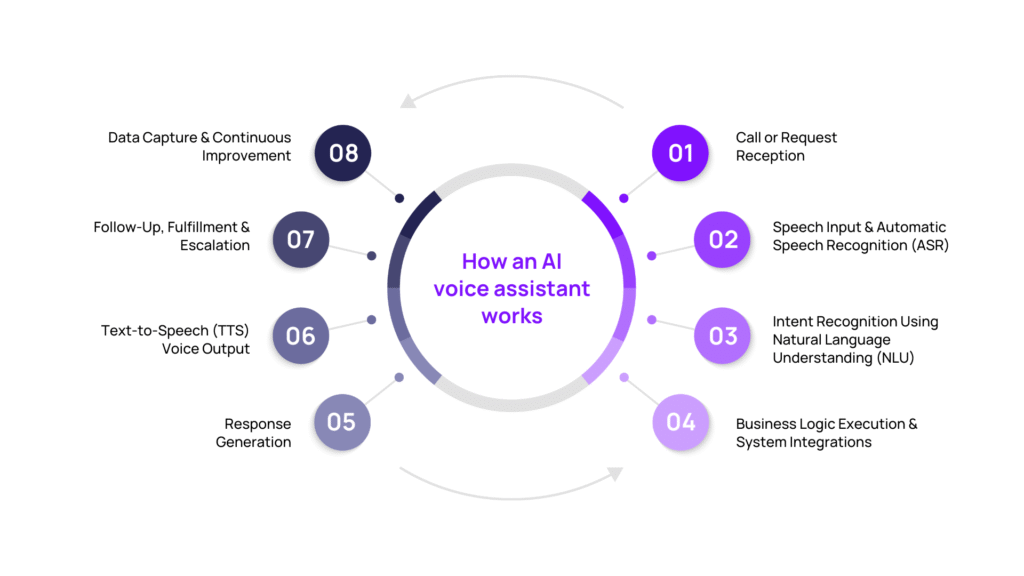
Step 1: Call or Request Reception
- The guest dials the hotel’s primary phone number
- Alternatively, the guest sends a voice request through the hotel app or digital channel
- The call is automatically routed to the Voice AI agent, either fully or alongside human operators
- No waiting, no call queue, no missed calls
Outcome:
Every incoming request is captured instantly by the AI voice assistant.
Step 2: Speech Input & Automatic Speech Recognition (ASR)
- The guest speaks naturally, without needing specific commands
- AI voice recognition software converts spoken language into text in real time
- The system handles accents, pacing, and conversational speech
- If required, the AI prompts the guest with clarifying questions
Outcome:
Accurate transcription of guest intent from natural speech.
Step 3: Intent Recognition Using Natural Language Understanding (NLU)
- The transcribed text is analyzed by the NLU engine
- The system identifies:
- Guest intent (e.g., room booking, modification, inquiry)
- Key details (dates, room type, number of guests, preferences)
- Example:
- “Book me two single rooms next weekend”
- Intent: book_room
- Entities: 2 rooms, single, next weekend
Outcome:
Clear understanding of what the guest wants and why they are calling.
Step 4: Business Logic Execution & System Integrations
- The Voice AI agent triggers the required business action
- Backend systems are accessed in real time, including:
- CRS / PMS for availability and pricing
- CRM for guest profile and loyalty data
- Knowledge base for hotel policies or local information
- The interaction is personalized using:
- Past stays
- Loyalty status
- Guest preferences
Outcome:
Accurate, personalized execution of the guest’s request.
Step 5: Response Generation
- The AI generates a response using:
- A conversational dialogue model, or
- Preapproved response templates (where required)
- Responses are clear, contextual, and human-like
Example Response:
“Great! I’ve reserved two single rooms for next Saturday at a rate of $X per night.”
Outcome:
A clear, confident confirmation delivered instantly.
Step 6: Text-to-Speech (TTS) Voice Output
- The response text is converted back into speech
- Modern TTS technology produces:
- Natural tone
- Conversational pacing
- Human-like voice quality
- The guest hears the response as if speaking to a trained staff member
Outcome:
A frictionless, voice-first guest experience.
Step 7: Follow-Up, Fulfillment & Escalation
- The conversation continues until the request is fully resolved
- If human action is required:
- The AI logs the task
- Staff are notified via SMS or staff applications
- If the AI detects uncertainty or complexity:
- The call is transferred to a human agent
- Full conversation context is passed along
Outcome:
No repetition, no confusion, smooth human handoff when needed.
Step 8: Data Capture & Continuous Improvement
- Every interaction is logged automatically, including:
- Conversation transcript
- Intent and outcome
- Resolution time
- The system analyzes trends such as:
- Peak call times
- Common guest questions
- Booking conversion patterns
Outcome:
Actionable insights that continuously improve guest service and operations.
Summary Table
| Step No. | Process Stage | Outcome |
|---|---|---|
| Step 1 | Call / Request Reception | Every guest call or voice request is instantly captured with zero missed calls |
| Step 2 | Speech Input & ASR | Guest’s natural speech is accurately converted into text in real time |
| Step 3 | Intent Recognition (NLU) | The system clearly understands what the guest wants and key details involved |
| Step 4 | Business Logic & System Integration | Real-time action is taken using PMS, CRS, CRM, or knowledge base data |
| Step 5 | Response Generation | A clear, contextual, and accurate response is prepared for the guest |
| Step 6 | Text-to-Speech Output | The response is delivered in a natural, human-like voice |
| Step 7 | Follow-Up, Fulfillment & Escalation | Requests are completed or seamlessly handed over to staff with full context |
| Step 8 | Data Capture & Analytics | Call data is logged to improve performance, insights, and future interactions |
Real Examples of Voice AI agents in Typical Hotel Scenarios
Scenario 1 — High-Intent Booking
| Guest Request | Voice AI Agent Response |
|---|---|
| “Do you have two rooms for Saturday?” | AI checks the PMS → Quotes available rates → Offers an upgraded category if eligible → Completes the booking |
Scenario 2 — OTA Modification Request
| Guest Request | Voice AI agent Response |
|---|---|
| “I booked on Booking.com. Can you shift my dates?” | AI verifies OTA booking → Checks restrictions → Modifies reservation → Sends updated confirmation |
AI reduces manual front desk effort by up to 80% for routine booking modifications
Scenario 3 — Pre-Arrival Service Request
| Guest Request | Voice AI agent Response |
|---|---|
| “I need airport pickup for tonight.” | AI logs the request → Creates a service ticket → Updates reservation notes |
Automated logging ensures 100% request traceability, improving operational efficiency
Scenario 4 — Night-Time Inquiry
| Guest Request | Voice AI Agent Response |
|---|---|
| “What time is breakfast? Also, can I request late checkout?” | AI provides policy information → Logs guest request → Confirms availability |
AI ensures round-the-clock guest support, especially outside reception hours, maintaining satisfaction and reducing staff workload
Scenario 5 — Rate Comparison Question
| Guest Request | Voice AI agent Response |
|---|---|
| “On Expedia I’m seeing €140, what’s your direct rate?” | AI pulls CRS rates → Explains benefits of booking direct → Encourages direct booking |
Studies show guests who interact with AI for rate queries are 25% more likely to book directly, driving revenue
Voice AI agent Use Cases in Hotels
Reservations and Bookings
The agent answers the phone or online voice chat and handles room reservations end-toend – checking rates, confirming dates, taking payment info, and emailing confirmations. For example, one resort reported that after deploying AI, the system now handles about 34% of all incoming reservation calls (over 300 bookings per week), significantly relieving human agents
Front Desk Queries
Guests calling with routine questions (“What time is check-out? Is breakfast included?”) receive instant, accurate answers. The AI can also handle check-in/out procedures by phone, verifying IDs via SMS links, or pre-assigning room numbers.
Concierge and Local Info
AI assistants can recommend restaurants, book taxis, or provide directions. They can access up-to-date local information, even suggesting special upsells (spa packages, event tickets) based on guest profile. They act like a virtual concierge available any time.
Room Service and Housekeeping
Guests can place orders or requests by speaking (“Please send up two pillows,” or “Add a breakfast to my bill”). The AI takes the request and automatically notifies relevant staff or systems.
Upselling and Promotions
While on the call, the AI can offer upgrades or add-ons (“Would you like to upgrade to a suite for an extra $50?”) in a natural way. Because it’s data-driven, it knows which promotions are relevant (e.g. loyalty members or guests on special packages).
Multi-language Support
Guests speaking different languages can be served without delay. If a guest calls in Mandarin, the AI recognizes and responds in Mandarin. This opens communication to many more potential customers.
Billing and Payments
The AI can answer billing questions (“What is the balance on my folio?”) or take credit card payments securely.
In essence, any task that a guest might call the front desk or reservations line for can potentially be handled by a voice AI assistant, often with greater speed and consistency. As one report notes, leading hotels are now deploying voice AI for reservations, room service, and other guest services to address labor shortages and provide multilingual support
Integration & Ecosystem: How Voice AI agents Fit Into the Hotel Technology Stack
CRS Integration: The Engine Behind Centralized Revenue Control
A Central Reservation System (CRS) acts as the authoritative source of truth for rates, inventory, and distribution rules across hotel portfolios. For Voice AI agents, CRS integration is what transforms simple call handling into enterprise-grade booking intelligence.
A CRS typically manages brand-wide room inventory, centralized pricing, negotiated rate segments, distribution logic, and booking policies. This becomes especially critical for hotel groups operating across multiple cities, regions, brands, or franchise networks, where rate consistency and inventory accuracy are non-negotiable.
- Accurate, Brand-Controlled Rate Distribution
When integrated with the CRS, an AI voice assistant always quotes rates that align with brand strategy. There is no risk of outdated pricing, incorrect promotions, or miscommunication at the call level. Every rate presented to the guest reflects centrally approved pricing logic.
- Multi-Property Availability Across Portfolios
CRS integration allows the Voice AI agent to view availability across sister properties in real time. If a specific hotel is fully booked, the system can intelligently
recommend alternative properties within the same brand or network, preserving the booking within the group rather than losing it to competitors.
- Policy-Driven Booking Logic
Booking rules such as minimum length of stay, blackout dates, early-bird offers, corporate agreements, and loyalty-based restrictions are enforced automatically
through CRS logic. The AI does not simply quote rates—it applies the same policy logic a trained revenue or reservations team would follow.
- OTA and Channel-Specific Rule Interpretation
For guests referencing OTA bookings or asking about channel discrepancies, the CRS serves as the authoritative source of rules. This enables the Voice AI agent to explain rate differences, restrictions, or conditions accurately and confidently.
Outcome:
CRS integration elevates an Voice AI agent into a brand-level booking engine capable of supporting complex, multi-property hospitality operations with centralized revenue control.
Integration with Channel Managers: Ensuring Rate Parity and Inventory Accuracy
Voice AI agents typically do not connect directly with channel managers. Instead, accuracy is achieved through the established PMS → CRS → Channel Manager ecosystem that governs hotel distribution.
This interconnected system ensures that availability remains consistent across all channels, room categories are correctly mapped, and rate parity is maintained. As a result, when an AI voice assistant quotes prices or explains discrepancies to guests, it does so using data that reflects the hotel’s live distribution environment.
Outcome:
Indirect channel manager integration ensures the Voice AI agent communicates accurate rates and availability, reducing guest confusion and protecting brand credibility.
CRM and Loyalty System Integration: Powering Personalized Guest Conversations
CRM integration enables Voice AI agents to move beyond generic responses and deliver truly personalized interactions. By accessing guest profiles, the AI gains visibility into stay history, preferences, loyalty tier, entitlements, and past communication records.
This allows the AI to acknowledge returning guests, reference prior stays, and tailor responses based on known preferences. Loyalty members can receive clear explanations around points, upgrades, special rates, or exclusive benefits without needing to speak to a human agent.
Over time, this contextual awareness allows the AI to anticipate needs—such as recognizing pillow preferences or recurring service requests—creating a more seamless and human-like experience.
Outcome:
CRM integration transforms Voice AI agents from functional support tools into personalized hospitality touchpoints that strengthen guest relationships.
Telephony Integration: Seamless Voice Automation Without Infrastructure Disruption
AI voice automation integrates directly with modern cloud telephony systems, SIP trunks, VoIP carriers, and even legacy PBX setups through adapters. This ensures hotels can adopt voice AI without changing their existing phone infrastructure.
Guests continue dialing the same hotel number they always have, but calls are instantly routed to the Voice AI agent. This eliminates hold times, ensures consistent call handling, and allows intelligent routing to staff when human involvement is required.
Telephony integration also provides full visibility into call activity, including call volumes, durations, and outcomes, enabling hotels to analyze and optimize voice operations.
Outcome:
Telephony integration delivers reliable, zero-disruption AI call handling while improving speed, visibility, and service consistency.
Integration with Analytics, Demand Intelligence, and Reporting Systems
Voice AI agents do more than respond to calls—they generate a rich layer of operational and commercial intelligence. Every interaction produces structured data, including call transcripts, intent classification, booking outcomes, peak calling times, language distribution, and unresolved queries.
This visibility allows hotels to identify demand patterns that were previously invisible, such as frequently asked questions, service bottlenecks, or missed revenue opportunities. Insights derived from voice interactions can inform staffing decisions, marketing campaigns, pricing strategies, and operational improvements.
Over time, this data transforms voice from a reactive support channel into a proactive intelligence layer that continuously improves guest satisfaction and business performance.
Outcome:
Analytics integration turns Voice AI agents into a strategic insight engine, enabling smarter
decisions across revenue, operations, and guest experience.
ROI of Voice AI agents for Hotels
Hotels do not adopt Voice AI agents because they are futuristic or experimental. They adopt them because the financial case is stronger, faster, and more predictable than most hospitality technologies introduced in the last decade.
- Sample Calculation: A small hotel taking 2,000 calls/month missing 30% (600 calls) with 40% booking intent (240 calls) at $225 each loses $54,000 in revenue monthly. Recapturing just 20% of that (via AI answering previously missed calls) yields an extra $10,800 per month (≈$130K/year). Similarly, if the hotel normally gets 300 direct bookings/month, a 10% uplift (30 extra bookings at $225 ADR) is $6,750 more per month (~$81K/year). A quick table of such ROI drivers:
| ROI Driver | Example/Assumption | Annual Impact (USD) |
|---|---|---|
| Recaptured Missed Bookings | 2,000 calls/mo, 30% missed, 40% intent, $225 | $129,600 (at 20% recapture) |
| Direct Booking Uplift | 300 bookings/mo, +10% from AI | $81,000 |
| Upsell Revenue | 1,000 calls, $10 upsell opportunity, 10% conv | $12,000 |
| Call Center Cost Reduction | 2,000 calls, $3 cost, 60% handled by AI | $43,200 |
| Night Staff Savings | Replacing one $2,000/mo agent | $24,000 (per agent) |
In sum, a moderately sized hotel could easily add hundreds of thousands in net benefits per year when combining recovered revenue, extra bookings, and operational savings.
What follows is a detailed ROI breakdown in USD, structured for decision-makers who require clarity, precision, and confidence in outcomes.
The Three Core Drivers of AI Voice ROI
The financial impact of Voice AI agents consistently comes from three interconnected drivers.
First, revenue that was previously lost due to missed calls is recovered. Second, total revenue increases as direct bookings and upsells rise. Third, operating costs decline as dependency on call centers and night staffing reduces.
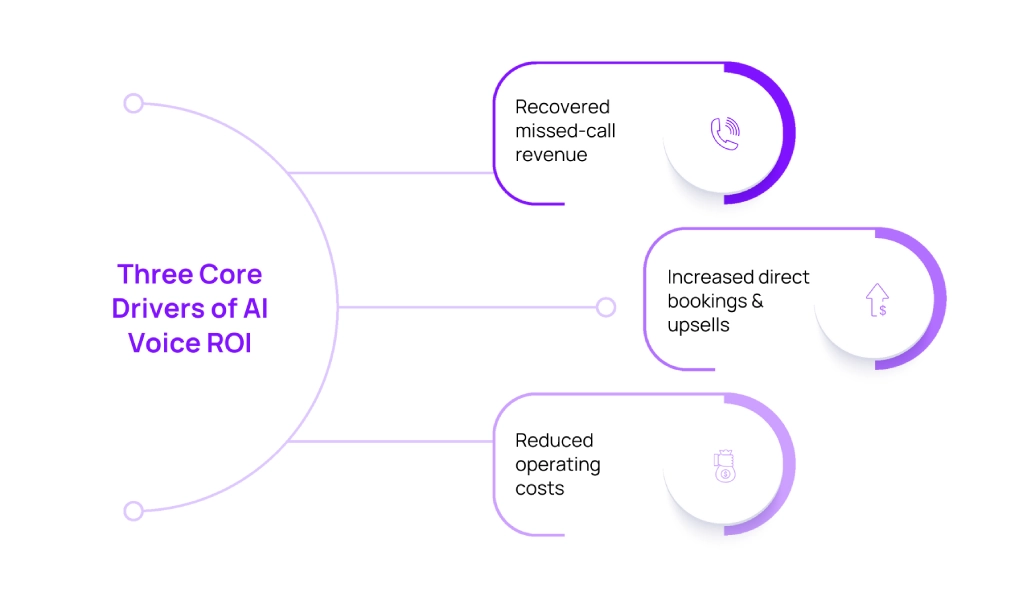
Every hotel benefits from all three drivers—the only variable is scale.
ROI Pillar 1: Revenue Recovered from Missed Calls
Hotels often underestimate how much revenue they lose simply because calls go unanswered. Across global hospitality markets, a significant portion of inbound calls are missed during peak periods, and many of those calls carry real booking intent. Each missed booking-intent call represents not just room revenue, but also lost upgrades, ancillary spend, and future loyalty.
- Revenue Recovery Calculation (USD)
Table: Missed Call Revenue Recovery
| Metric | Value |
|---|---|
| Monthly inbound calls | 2,000 |
| Calls missed | 30% (600 calls) |
| Calls with booking intent | 40% (240 calls) |
| Average booking value | $225 |
| Monthly revenue lost | $54,000 |
| Conservative recovery (20%) | $10,800/month |
| Annual recovered revenue | $129,600 |
This recovery alone often justifies AI voice deployment before considering any additional uplift.
ROI Pillar 2: Increased Direct Bookings
Direct bookings increase when guests receive instant responses, clear explanations, and reassurance during high-intent moments. Voice AI agents remove hold times, answer confidently, and explain direct-channel advantages without hesitation.
Hotels typically see measurable uplift within the first 60–90 days of deployment.
- Direct Booking Uplift Example (USD)
Table: Direct Booking Revenue Increase
| Metric | Value |
|---|---|
| Monthly direct bookings | 300 |
| Conversion uplift | 10% |
| Incremental bookings | 30 |
| Average booking value | $225 |
| Monthly incremental revenue | $6,750 |
| Annual incremental revenue | $81,000 |
This figure excludes OTA commission savings, which often add another 15–20% in effective margin gain.
ROI Pillar 3: Upsell Revenue Growth
Upselling is one of the most inconsistent revenue streams in hotel operations due to staff variability and workload. Voice AI agents solve this by presenting upsells consistently, without fatigue or hesitation.
Room upgrades, meal plans, flexible rates, spa services, and transfers are introduced naturally during relevant calls.
- Upsell Revenue Example (USD)
Table: Voice-Driven Upsell Impact
| Metric | Value |
|---|---|
| Eligible calls per month | 1,000 |
| Average upsell value | $10 |
| Total upsell opportunity | $10,000 |
| Conversion rate | 10% |
| Monthly upsell revenue | $1,000 |
| Annual upsell revenue | $12,000 |
Resorts and leisure properties typically see significantly higher upsell values due to broader inventory and experiences.
ROI Pillar 4: Call Center Cost Reduction
Many hotels rely on outsourced call centers or internal teams to manage inbound calls. These costs scale directly with volume and become especially expensive during peak seasons.
Voice AI agents absorb a large percentage of routine and booking-related calls, reducing external and internal call handling costs.
- Call Center Savings Example (USD)
Table: Call Handling Cost Reduction
| Metric | Value |
|---|---|
| Monthly calls | 2,000 |
| Cost per call | $3 |
| Monthly call center cost | $6,000 |
| Calls handled by AI | 60% (1,200) |
| Monthly cost saved | $3,600 |
| Annual cost saved | $43,200 |
For hotel groups, these savings scale rapidly across properties.
ROI Pillar 5: Night-Shift Labor Savings
Maintaining overnight front desk or call coverage is expensive and difficult to staff consistently. Voice AI agents handle booking calls, service requests, late check-ins, and international inquiries without human presence.
- Night-Shift Cost Savings (USD)
Table: Night Coverage Savings
| Metric | Value |
|---|---|
| Average monthly night-shift cost | $2,000 |
| Coverage replaced by AI | Yes |
| Monthly savings | $2,000 |
| Annual savings | $24,000 |
Hotels requiring multiple night agents see these savings multiply proportionally.
ROI Pillar 6: Multi-Property and Chain-Level ROI
For hotel chains and portfolios, Voice AI agents enable centralized voice operations, shared intelligence, and consistent brand communication across properties.
- Portfolio-Level Impact Example (USD)
Table: Chain-Level ROI (10 Properties)
| Metric | Value |
|---|---|
| Monthly impact per hotel | $20,000 |
| Number of hotels | 10 |
| Annual portfolio impact | $2,400,000 |
At scale, AI voice becomes a growth engine rather than a point solution.
The 30–90 Day ROI Window
Voice AI agents deliver ROI faster than almost any other hospitality technology.
| Timeline | Outcome |
|---|---|
| Weeks 1–2 | Integration and testing |
| Weeks 3–4 | 40–60% calls handled by AI |
| Month 2–3 | Direct booking uplift visible |
| Month 3–4 | Full ROI clarity |
| Typical payback period | 30–90 days |
This ROI timeline is significantly faster than PMS upgrades (6–18 months), CRM adoption (9–24 months), mobile app rollouts (high cost, low adoption), and digital marketing initiatives (variable ROI).
ROI Scenarios by Hotel Type
Scenario A: Mid-Sized Independent Hotel (2,000 Calls/Month)
| Pillar | Monthly Impact |
|---|---|
| Recovered revenue | $10,800 |
| Direct booking uplift | $6,750 |
| Call center savings | $3,600 |
| Upsell revenue | $1,000 |
| Total Monthly Impact | $22,150 |
| Annual Impact | $265,800 |
Scenario B: Resort or Leisure Property (5,000 Calls/Month)
| Pillar | Monthly Impact |
|---|---|
| Recovered revenue | $25,000 |
| Upsell uplift | $3,000 |
| Night-shift savings | $2,000 |
| Operational gains | $10,000 |
| Total Monthly Impact | $40,000 |
| Annual Impact | $480,000 |
Scenario C: Multi-Property Chain
| Metric | Value |
|---|---|
| Monthly call volume | 20,000+ |
| Deployment model | Centralized AI |
| Estimated annual impact | $2M–$3M |
These numbers are conservative. Many chains exceed them based on ADR and call volume.
Frequently Asked Questions About Voice AI agents for Hotels
Voice AI agents are still relatively new in hospitality, and while adoption is accelerating globally, hotel leaders understandably have operational, technical, and commercial questions before deployment. This FAQ section answers the most common questions asked by hotel owners, GMs, revenue leaders, and technology teams.
Can an Voice AI agent handle real hotel reservations?
Yes. Modern Voice AI agents integrate directly with a hotel’s PMS and CRS, enabling them to handle real reservations end to end. They can check live availability, quote accurate rates, apply policies and restrictions, create new bookings, modify or cancel existing reservations (where permitted), capture guest preferences, and send confirmations via email or SMS. Functionally, they operate with the same system access and accuracy as a trained reservations agent—while being available 24×7.
Does an Voice AI agent replace front-desk or reservations staff?
No. Voice AI agents are designed to augment hotel teams, not replace them. They take over repetitive, high-volume tasks such as availability checks, rate questions, and basic service requests. This allows hotel staff to focus on in-person guest interactions, escalations, service recovery, personalized hospitality, and revenue-generating conversations. Human judgment remains essential in hospitality; AI simply removes operational noise.
Is AI voice reliable for complex guest questions?
Yes. Today’s Voice AI agents use advanced natural language processing and large language models trained specifically for hospitality. They can understand multi-intent queries, incomplete sentences, accents, and follow-up questions, even in noisy environments. Because they pull rules and logic directly from the PMS, CRS, and hotel policies, responses remain accurate—even for OTA-related or policy-driven questions.
Can Voice AI agents support multiple languages?
Absolutely. Most enterprise-grade AI voice platforms support 20–30+ languages and regional accents, including English, Spanish, French, German, Arabic, Hindi, Mandarin, Thai, and more. This removes the dependency on multilingual staffing and ensures international guests receive consistent, high-quality service at all times.
How is guest privacy and data security handled?
AI voice platforms are built to comply with global data-protection and security standards such as GDPR, SOC 2, and PCI-DSS where applicable. Data is encrypted in transit, access is role-based, retention policies are strictly controlled, and sensitive payment data is not stored. Hotels retain full ownership and control of guest data at all times.
How quickly can a hotel deploy an Voice AI agent?
Most hotels can go live within 7 to 21 days. Deployment timelines depend on factors such as PMS or CRS integration, telephony setup, call-routing logic, custom scripts, and multilingual requirements. Compared to many hospitality technologies, AI voice has one of the fastest implementation cycles with minimal operational disruption.
What happens when a guest needs to speak to a human?
When a query requires human judgment or intervention, the AI automatically detects the need for escalation. The call is transferred instantly to the appropriate hotel team member, along with full conversation context. This ensures staff don’t have to repeat questions or start from scratch. AI handles the majority of calls and escalates only when necessary.
What KPIs should hotels track after deploying AI voice?
Hotels should track both operational and revenue-focused KPIs to measure impact. Key metrics include call answer rate and missed-call reduction, which indicate service accessibility; direct booking conversion and upsell revenue, which reflect revenue performance; and average handling time, which shows efficiency gains. Guest satisfaction scores, complaint reduction, and cost savings from reduced staffing or call-center dependency are also critical indicators of overall success and ROI.
Can Voice AI agents manage night-time calls?
Yes. Voice AI agents operate 24×7 without fatigue. They support late arrivals, last-minute bookings, international callers across time zones, and urgent requests during overnight hours. Emergencies are escalated to on-duty staff, ensuring no guest is ever told to “call back tomorrow.” Night-time coverage is one of the strongest ROI drivers for hotels.
What types of hotel calls does AI handle best?
Voice AI agents excel at high-frequency, repetitive calls that overwhelm hotel teams. These include reservation inquiries, OTA modification questions, booking confirmations, rate and availability checks, property information, early check-in or late checkout requests, housekeeping or maintenance requests, directions, parking details, airport transfers, and in-stay service inquiries.
How does the AI know hotel policies, rates, and restrictions?
All information is pulled directly from authoritative hotel systems and configurations, including the PMS, CRS, brand policy documents, standard operating procedures, and custom property inputs. The AI follows the same rules as the reservations team but applies them consistently, accurately, and without deviation.
Does AI voice automation reduce OTA dependence?
Yes. Voice AI agents significantly reduce missed-call scenarios that often lead guests to book via OTAs. Guests receive instant answers over the phone, clear explanations of rate differences, and confident responses to price-comparison questions. Built-in upsell logic further encourages direct bookings, helping hotels regain control over distribution.
Can AI voice capture leads even if a guest doesn’t book?
Yes. Even when a booking is not completed during the call, Voice AI agents can still capture high-value leads. The system can securely collect contact details such as phone number or email, understand travel intent (dates, destination, room type, budget, purpose of travel), and log follow-up requests. These leads are automatically shared with the reservations or sales team through the CRM or PMS, enabling timely callbacks, personalized offers, or email follow-ups.
Is AI voice technology expensive for hotels?
AI voice is highly cost-effective when compared to labor costs, call-center contracts, missed-call revenue, OTA commissions, night-shift staffing, and operational inefficiencies. Most hotels recover their investment within 30–90 days, with multi-property groups achieving even faster ROI due to scale.
How does AI handle seasonal call spikes?
Voice AI agents scale instantly to handle peak travel seasons, weekends, events, festivals, weather disruptions, and last-minute booking surges. Unlike human teams, AI never queues calls or degrades service quality during demand spikes, ensuring revenue opportunities are never lost.
Can Voice AI agents work across multiple hotel properties?
Yes. Voice AI agents are ideal for centralized reservations and multi-property groups. They support intelligent call routing, cross-property availability suggestions, unified brand tone, and standardized policies—making them especially valuable for chains and hotel groups.
How does AI voice handle accents and call quality issues?
Modern Voice AI agents use advanced speech recognition models trained on hospitality-specific call data from diverse geographies. This allows them to accurately understand different accents, speech patterns, and languages. They are also optimized to handle real-world conditions such as background noise, poor call quality, and interrupted speech. Context awareness and confirmation logic help reduce errors, ensuring guests are understood clearly even in challenging audio environments.
Voice AI agents in Hospitality: Global Trends and Forecasts
Geographic Deployment Trends

North America
North America leads hospitality voice-agent adoption, driven by tech-savvy guests and luxury hotel chains. In 2024 the North American market was ~$0.57 B. Major hotel groups (e.g. Marriott, Hilton) have piloted voice assistants: Marriott trialed Amazon’s Alexa in guest rooms. These in-room devices let guests control lights, temperature, or request services by voice. Voice assistants help relieve staffing pressure by handling routine guest questions. For example, Marriott’s Alexa trials in Charlotte and Irvine allow guests to ask for housekeeping or order room service. Privacy concerns have been noted (e.g. some guests finding in-room Alexa intrusive), but hotels emphasize guest choice and data deletion policies. Emerging US/Canadian deployments increasingly tie voice AI into contactless and mobile systems to improve service and revenue (e.g. guest rebooking prompts).
Voice assistants are entering North American hotels. Marriott, an early adopter, trialed Alexa in rooms as a “virtual concierge”.
Europe
Europe is the second-largest market (~$0.39 B in 2024). European hotels emphasize multilingual and personalized experiences. The region’s diverse languages and strict data regulations present challenges, pushing vendors to build solutions supporting
many languages and on-device privacy. For instance, major chains like Accor and others are experimenting with Google Home/Philips Hue or Amazon Echo in rooms (as part of “smart room” initiatives). Overall growth is strong (projected ≈20% CAGR), with voice agents improving guest engagement (e.g. French hotels offering in-room tablets with voice, and London’s Mercure Hyde Park trialing Alexa Smart Properties). Voice AI also integrates into European cruise and resort contexts, though on-ship adoption is nascent.
Asia-Pacific
APAC is the fastest-growing region (≈$0.28 B in 2024, ~25.3% CAGR). Hotels in China, Japan, India and Southeast Asia are rapidly adopting voice AI. For example, Millennium Hotels & Resorts rolled out the Aiello Voice Assistant (AVA) in six properties across Singapore and Thailand. These devices let guests make requests and control room features by voice, while reducing printed materials and enabling energy savings. Many APAC hospitality groups (e.g. in Singapore, Malaysia, Australia) view voice AI as key to personalization and sustainability. The region’s high smartphone/IoT penetration and growing tourism support this trend; local solutions are being adapted to multiple languages and dialects. Major APAC hotel chains are forging tech partnerships to embed AI concierges, and voice guest interfaces are emerging in Asian cruise lines and resorts.
Middle East & Africa (MEA) and Latin America
MEA and Latin America are the smallest markets (~$0.18 B combined in 2024). Adoption is emerging, led by luxury hotels in the Gulf and South Africa investing in smart-room concepts. For example, some UAE hotels have piloted voice-controlled IoT in rooms (lights, blinds) and AI front-desk chatbots. Growth is uneven: while the Middle East has high-end properties experimenting with voice concierge platforms, Africa and Latin America show slower uptake due to cost and infrastructure constraints. Nevertheless, several Middle Eastern hospitality groups cite voice AI as a way to differentiate service (and even address labor shortages), suggesting uptake may accelerate with region-focused solutions (e.g. Arabic-language support).
| Region | 2024 Market Size & Growth | Adoption Drivers |
|---|---|---|
| North America | ~$0.57B (largest market) | Tech-savvy guests, luxury hotel chains, labor shortages |
| Europe | ~$0.39B (~20% CAGR) | Multilingual demand, personalization, smart-room initiatives |
| Asia-Pacific (APAC) | ~$0.28B (~25.3% CAGR – fastest growing) | Rapid tourism growth, IoT adoption, sustainability focus |
| Middle East & Africa (MEA) | Emerging market | Luxury positioning, service differentiation, labor optimization |
| Latin America | Early-stage adoption | Gradual digitization, cost sensitivity |
Emerging Trends and Innovations in Voice AI agent
The next phase of growth for AI in voice assistants is being shaped by several clear trends that are redefining how hotels use voice technology.
Multilingual and Multichannel Voice Experiences
Modern Voice AI agent are designed to support dozens of languages and operate across voice, phone, and messaging channels. Many hotels now rely on voice AI assistants that function 24/7 and switch languages seamlessly, making them suitable for international guests and global brands. This capability is becoming a baseline expectation rather than a premium feature.
IoT and Smart Room Integration
Voice assistants are increasingly connected to in-room technology. Guests can adjust lighting, temperature, curtains, or entertainment using a single voice command. This integration transforms the AI voice assistant into a central control layer for the guest experience, while also reducing reliance on printed guides and manual controls— supporting both efficiency and sustainability goals.
Personalization Through AI and Data
Advanced AI powered voice assistants now learn from guest interactions over time. Preferences such as room temperature, amenity choices, or service timing can be remembered and applied automatically. This shift from scripted responses to adaptive conversations allows hotels to deliver personalization at scale—something traditional front desks struggle to achieve consistently.
Unified Guest Engagement Across Voice and Messaging
Hotels are increasingly deploying voice recognition software that connects phone-based AI agents with messaging platforms like WhatsApp or SMS. A guest may begin with a voice call and continue the conversation via text, creating a seamless experience. This unified approach turns voice into a core part of the hotel’s broader guest communication ecosystem.
More Natural, Conversational AI
Thanks to advances in natural language processing and generative AI, today’s most advanced voice assistants can handle open-ended questions, follow-up queries, and complex requests. These systems feel less like IVRs and more like trained hotel staff, capable of understanding incomplete sentences, emotional cues, and real-world speech patterns.
Privacy, Trust, and Accessibility
As adoption grows, privacy and ethical design are becoming central. Hotels increasingly allow guests to opt in or out of voice services, anonymize recordings, and process data securely. At the same time, voice technology is improving accessibility, helping visually impaired guests and enabling clearer communication for non-native speakers.
Together, these trends signal a clear direction: voice AI agent is moving from a convenience feature to a foundational layer of hotel operations. As this happens, hospitality-specific platforms—such as CRS-integrated voice systems like UNO VIVA—are shaping how the next generation of best Voice AI agent for hotels will be defined: not by novelty, but by reliability, accuracy, and real operational impact.
Conclusion
The hospitality industry is entering a new phase of automation—one where voice plays a central role in how hotels sell, serve, and scale. As guest expectations rise and staffing challenges persist, Voice AI agent is stepping in to ensure no call goes unanswered and no booking opportunity is missed.
What’s clear from market adoption and competitive innovation is that not all Voice AI agent is created equal. Generic voice tools may handle basic queries, but hotels increasingly need voice AI agent that can:
- Integrate deeply with PMS and CRS systems
- Handle real-time bookings and policy logic
- Support multilingual, high-intent guest conversations
- Deliver measurable impact on revenue and efficiency
As the market matures, the distinction between “voice as a feature” and “voice as an operational engine” will become even more pronounced. Hotels evaluating the best Voice AI agent for their business will look beyond novelty toward solutions that are reliable, scalable, and designed specifically for hospitality workflows.
This shift explains why industry-first platforms—such as UNO VIVA—are emerging as reference points in conversations around AI voice booking and revenue automation. Not because of marketing claims, but because they align closely with how hotels actually operate.
Glossary: Voice AI Agents in Hospitality
Voice AI Agent
A voice-first, AI-powered assistant that answers hotel calls, understands guest intent, and performs real-time actions such as bookings, modifications, and service requests.
Challenges with Current Hotel Call Systems
Traditional call handling relies on IVRs and staff availability, leading to missed calls, long wait times, language barriers, and lost booking revenue.
Why Voice AI Is a Must-Have for Hotels
Voice AI ensures 24/7 call coverage, instant responses, multilingual support, reduced staff workload, and higher direct booking conversions.
Voice AI Agent vs Traditional IVR
IVRs follow rigid menus, while Voice AI enables natural conversations, understands complex requests, and integrates with PMS and CRS systems to take action.
Use Cases and Real-World Examples
Common scenarios include reservation inquiries, OTA changes, pre-arrival services, nighttime questions, and rate comparison calls.
Deploying a Voice AI Agent
Deployment involves integrating the voice agent with telephony, PMS, CRS, and service systems to automate guest calls end to end.
Frequently Asked Questions About Voice AI for Hotels
FAQs typically cover accuracy, language support, integrations, data privacy, booking reliability, and staff escalation workflows.
Voice AI in Hospitality: Global Trends and Forecasts
The hospitality voice AI market is growing rapidly, driven by demand for contactless service, automation, and always-on guest engagement.
Emerging Trends in Voice AI Agents
Key trends include multilingual voice, CRS-integrated bookings, smart-room integration, personalization through AI, and unified voice-to-messaging experiences.
Calculating the ROI of a Voice AI Agent
ROI is measured through recovered missed-call revenue, increased direct bookings, reduced OTA leakage, and lower operational costs.
Conclusion
Voice AI is becoming a foundational layer in modern hotel operations, combining human like conversations with scalable automation and revenue impact.